

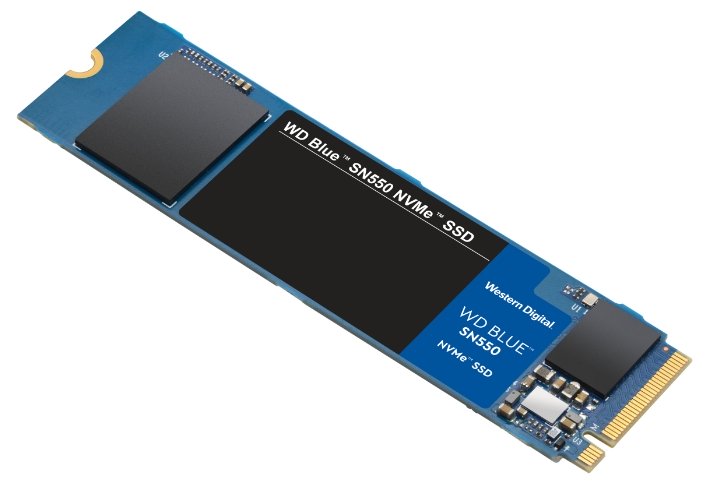
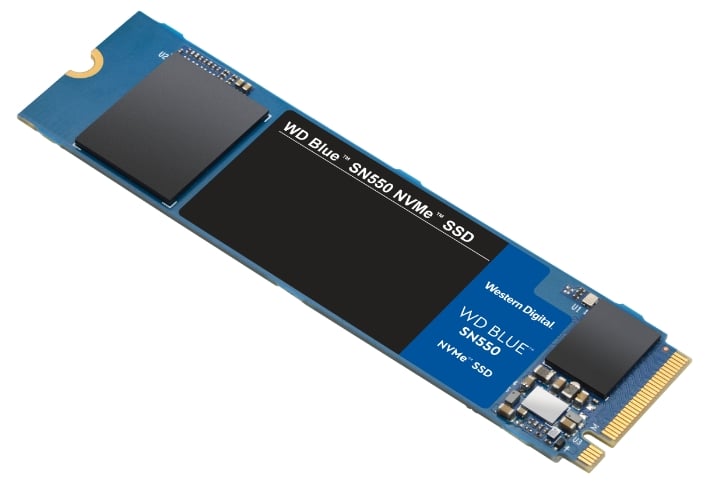
Western Digital today announced its new WD Blue SN550 family of SSDs, which will in effect replace the existing SN500 SKUs. These aren’t the company’s highest-performing storage solutions, but they do offer a compelling balance of good performance at reasonable price points for those looking to replace a HDD or simply build a low-cost gaming rig.
WD SN550 SSDs uses a 4-lane PCIe 3.0 interface along with a Western Digital-designed SSD controller and an in-house 96-layer 3D TLC NAND. Although these are considered entry-level PCIe SSDs, they offer a significant boost in performance over Western Digital’s existing SATA products, with the company citing a 4x uplift in read speeds.
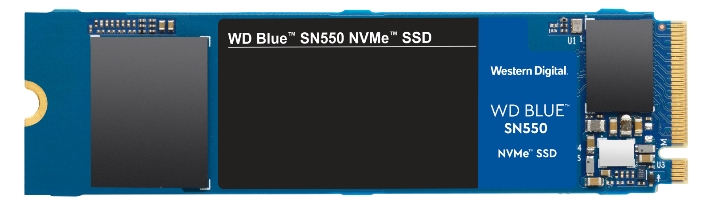
Western Digital is offering the WD SN550 family in three storage configurations: 256GB, 512GB, and 1TB. Sequential reads for all three SKUs are rated for the same 2.4GB/sec, while sequential writes are dependent on storage size. As you might expect, the 250GB SKU puts up the poorest showing here at 950MB/sec, while the 1TB SKU delivers the best sequential write performance at 1.9GB/sec. Random reads range from 170K IOPS (256GB) to 410K IOPS (1TB), while random writes range from 135K IOPS (256GB) to 405K IOPS (1TB).
“The WD Blue SN550 is a great option for customers looking for an all-NVMe portfolio,” said Eric Spanneut, Western Digital VP and GM for the Client Business Unit. “For a system builder, it means Western Digital delivers a full portfolio of NVMe and SATA SSDs, as well as high-capacity hard drives. This gives them immense flexibility to build systems for our customers’ varying needs.”
The new WD SN550 family is priced at $54.99, $64.99, and $99.99 respectively for the 256GB, 512GB, an 1TB SKUs, and all come backed by a 5-year warranty. However, expect for those prices to start falling once they enter the channel.
‘).insertAfter(jQuery(‘#initdisqus’));
}
loadDisqus(jQuery(‘#initdisqus’), disqus_identifier, url);
}
else {
setTimeout(function () { disqusDefer(); }, 50);
}
}
disqusDefer();
function loadDisqus(source, identifier, url) {
if (jQuery(“#disqus_thread”).length) {
jQuery(“#disqus_thread”).remove();
}
jQuery(‘
‘).insertAfter(source);
if (window.DISQUS) {
DISQUS.reset({
reload: true,
config: function () {
this.page.identifier = identifier;
this.page.url = url;
}
});
} else {
//insert a wrapper in HTML after the relevant “show comments” link
disqus_identifier = identifier; //set the identifier argument
disqus_url = url; //set the permalink argument
//append the Disqus embed script to HTML
var dsq = document.createElement(‘script’); dsq.type = ‘text/javascript’; dsq.async = true;
dsq.src = ‘https://’ + disqus_shortname + ‘.disqus.com/embed.js’;
jQuery(‘head’).append(dsq);
}
jQuery(‘.show-disqus’).show();
source.hide();
};
function disqusEvent()
{
idleTime = 0;
}