


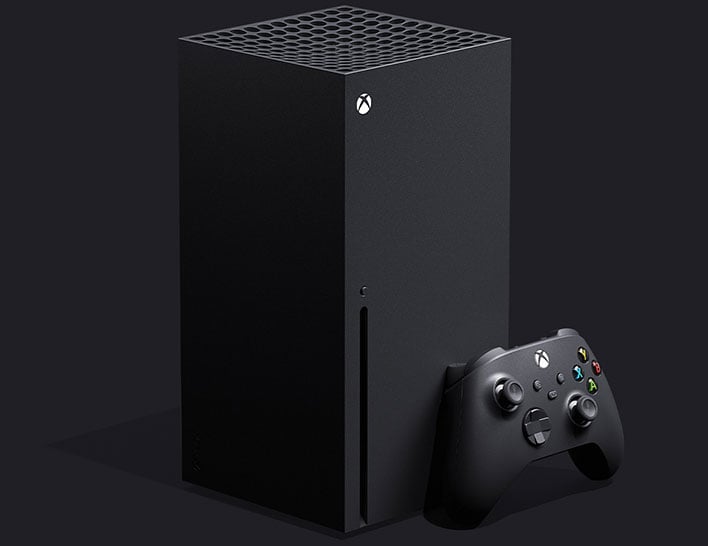
Richard Leadbetter at Eurogamer ran with that statement (and others made by Microsoft) to sort of guesstimate the kind of power we’re looking at here. Assuming that the transistor density has probably doubled in going from custom 16nm silicon to 7nm silicon, part of the performance gains will likely come from higher GPU frequencies.
Looking at just raw teraflops (TFLOPs), the Xbox Series X will be around a 12 TFLOPs system, based on Microsoft’s performance-doubling comments (compared to the Xbox One X). Part of that will come from architectural improvements introduced by Navi, in addition to faster clocks. According to Leadbetter, that suggests a 9-10 TFLOP Navi GPU combined with further architectural tweaks would get Microsoft to the place it says the Xbox Series X will be at, compared to the Xbox One X.
It’s very likely this is why Microsoft went with a tower design. The Xbox Series X continues the console’s march into PC territory, and all the power it is presumably comes with will require good airflow and capable cooling. It’s quite possible the console as a whole tops 300W when all is said and done.
As to the storage scheme, Microsoft’s Phil Spencer said the Xbox One X will deliver a 40x improvement in I/O speed. That translates into 1.6GB/s (sequential reads) or 2.4GB/s, depending on which generation of the Xbox One he is comparing to. Either way, today’s PCIe 3.0 NVMe SSDs would be sufficient to meet that performance claim.
There’s much more to digest. When you have a moment, we recommend hitting the link in the Via field below to read Leadbetter’s full analysis.
‘).insertAfter(jQuery(‘#initdisqus’));
}
loadDisqus(jQuery(‘#initdisqus’), disqus_identifier, url);
}
else {
setTimeout(function () { disqusDefer(); }, 50);
}
}
disqusDefer();
function loadDisqus(source, identifier, url) {
if (jQuery(“#disqus_thread”).length) {
jQuery(“#disqus_thread”).remove();
}
jQuery(‘
‘).insertAfter(source);
if (window.DISQUS) {
DISQUS.reset({
reload: true,
config: function () {
this.page.identifier = identifier;
this.page.url = url;
}
});
} else {
//insert a wrapper in HTML after the relevant “show comments” link
disqus_identifier = identifier; //set the identifier argument
disqus_url = url; //set the permalink argument
//append the Disqus embed script to HTML
var dsq = document.createElement(‘script’); dsq.type = ‘text/javascript’; dsq.async = true;
dsq.src = ‘https://’ + disqus_shortname + ‘.disqus.com/embed.js’;
jQuery(‘head’).append(dsq);
}
jQuery(‘.show-disqus’).show();
source.hide();
};
function disqusEvent()
{
idleTime = 0;
}