

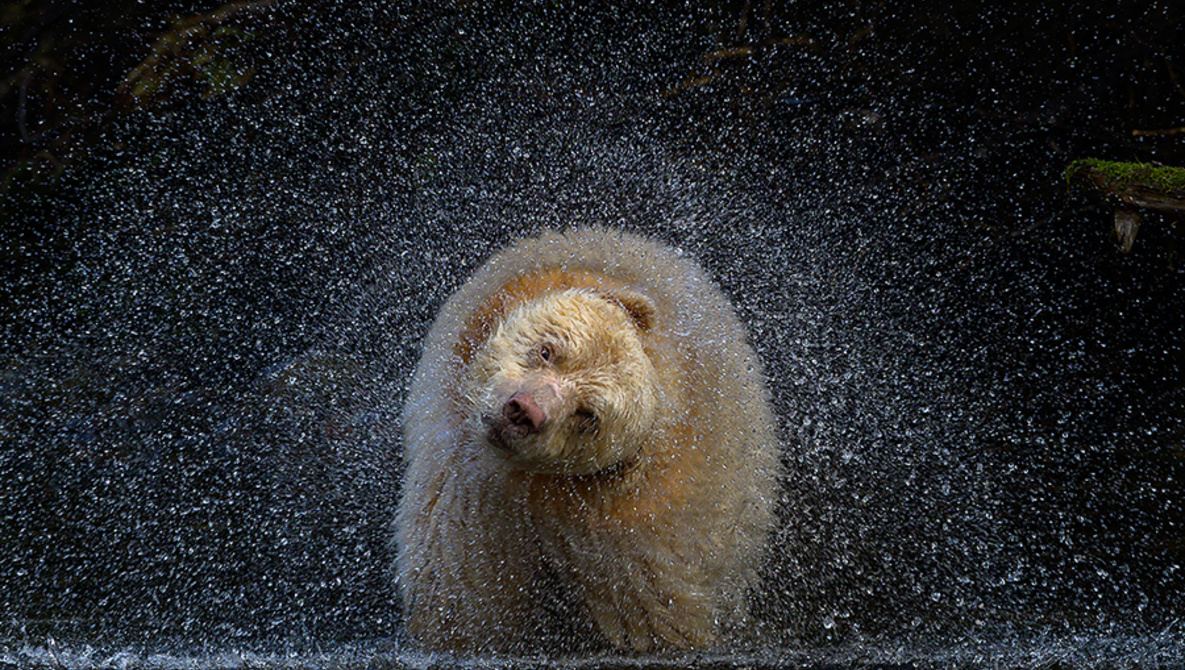
Imagine you’re somewhere deep in the Pacific Rain Forest to take pictures of the elusive spirit bear. It’s wet, and it’s cold. On top of that, the light is patchy, the shadows are dark. There’s a bit of movement down river. You lift your camera to your eye to capture the moment. In your imagination, what were you holding? A DSLR and a long lens? In actual fact, for some photographers, more and more often, it’s a mirrorless kit.
Michelle Valberg was a recent guest speaker at Vistek’s ProFusion Expo in Toronto. At ProFusion, Valberg spoke about why she is increasingly leaving her DSLR behind these days in favor of her mirrorless kit. Valberg has the credentials: she is a renowned wildlife photographer, Nikon Ambassador, and photographer in residence for CanGeo. Canada Post also recently used her bear images for our stamps.
Given her credentials, Valberg’s opinion should be seriously considered by anyone thinking about mirrorless.
I’d be remiss if I didn’t suggest you also check out her not-for-profit of choice, Project North, an organization dedicated to improving the lives of children in Canada’s north through sport and education. Inspiring stuff!
So, why does Valberg now favor mirrorless?
An Electronic Viewfinder is Key
Valberg is emphatic that an electronic viewfinder (EVF) is the best thing to happen to photography since the advent of digital. She explained to me that she would put the EVF first on any list of mirrorless advantages because of live exposure and focus peaking.
Live Exposure
First, let’s agree that using the LCD to review your images is a fantastic advantage over older film cameras. Instantaneous feedback offers you the chance to make corrections that would have taken hours or weeks with film. These days, it can be the difference between getting that fleeting moment nailed or letting it slip by. For any photographer who shoots in a situation where the subject is out of their control, it’s an advantage you’d be foolish to pass on.
Moving back and forward between your viewfinder and the LCD is a recipe for missing out. Wildlife can move so quickly that if you move away from your viewfinder for a moment, you may miss your shot.
Most wildlife photography takes place during the transition hours: from darkness through blue hour and golden hour and back. Light can change quickly. Valberg stressed that being able to see the light change and see how your adjustments are compensating for the changes without lifting your eye from the viewfinder puts you seconds ahead of those taking an eye off their viewfinder to check out their LCD.
Similarly, if you’re interested in getting a shot of something moving through shadows or just about to burst from the shadows, think a leopard stalking its prey, the EVF will let you see what your exposure will look like before the big cat takes those final steps.
When some moments come and go in less than a second, this could clearly come in handy.
On a related note, an EVF can help out when you quite simply can’t take your eye from the viewfinder. Imagine you’re set up and waiting for a bear, and then, the light changes just as the bear ambles out of the treeline 50 feet away you. There is no way you can move your camera from your eye to check out your LCD. As Valberg explained it, at this point, you’re committed to your camera or you’re not. If you have your camera up, shoot away; if not, don’t even think about moving. Doing so is either going to provoke one of the largest apex predators on earth or scare it away. Sure, you can make an educated case with an optical viewfinder and adjust using your experience, or with an EVF, you can guarantee you’re getting the exposure you want.
Valberg is also a proponent of the creative uses of an EVF. Shooting in black and white is a difficult art to learn. Seeing your images as black and white right in front of your eye as you adjust your exposure is very helpful in achieving the look you want. Using the EVF this way can really help fast-track the learning process for beginners and help experienced pros really dial in their vision.
Focus Peaking
For those of you who have shot wildlife, you’ll know that a really long lens will mean that even shooting at f/5.6 will mean that the animal may move in and out of focus just by breathing. Autofocus is great. But, sometimes it doesn’t pick out the eye, instead maybe focusing on a whisker or horn. Valberg shoots using autofocus and then manually adjusting, relying on focus peaking to make sure she’s focused where she wants to be. As she explained, she is able to use much wider apertures than typical in wildlife photography, even creating amazing portraits at f/2.8 and f/4.
Light Weight
It can often take very serious physical efforts to get to the places where the wildlife is still wild. Valberg is an avid kayaker and often shoots from her kayak. Taking away the mirror box and the related bulk from a camera gives mirrorless cameras the opportunity to be smaller and lighter.
I’ll tell you, when we hiked the volcanoes in Rwanda to visit the mountain gorillas, we really wished we had had lighter gear. You only get to visit the gorillas for an hour so that they don’t get too stressed. We must have spent the first 10 minutes just catching our breath.
True Silent Mode
Anything with a mirror is going to make noise when you press the shutter. Modern DSLRs can be quite quiet, but they still make noise. Sure, you could put your camera in a blimp if you’re sitting in a hide, but there’s no way you’re hiking around a rainforest with one.
If you’re trying to be still enough to capture wildlife, the silence of mirrorless is going to provide a bit of an edge over its mirrored counterparts. Most of us grew up with the sound of mirror slap, so it somehow feels comforting. There are even apps to add those sounds to alerts on your phone. But, as Valberg also pointed out, even if you’re just looking to be quiet by yourself in the environment, the snap of a mirror can take you out of that peace.
I loved the sound [of Nikon’s mirror slap]. Now, I love the silence, especially with wildlife.
Still to Video
Finally, Valberg mentioned mirrorless’ ability to switch between still and video without having to move more than a finger, never getting a blacked-out viewfinder as you would with DSLRs. By keeping the camera to your face, you can shoot away and switch between mediums as the subject requires.
Missing Your DSLR?
I asked Valberg what she missed most about her DSLRs. She said that she flat out doesn’t. Valberg explained that if she picks one up now, it feels far too heavy, like a tank when she wants a nimble kayak.
In the end, Valberg explained that she doesn’t pack her DSLRs anymore.
If I missed it, I would still have one in my camera bag. Sadly, I sold my D5, and I leave my D850 at home.
Your Thoughts
There is a lot of money invested in DSLRs and their lenses. If they are to go the way of the dodo, will you use this as a chance to stock up, or will you hop on the mirrorless train? What do you think will push you into converting? What do you think you’ll miss most about your DSLR?
All images provide courtesy of Michelle Valberg.