

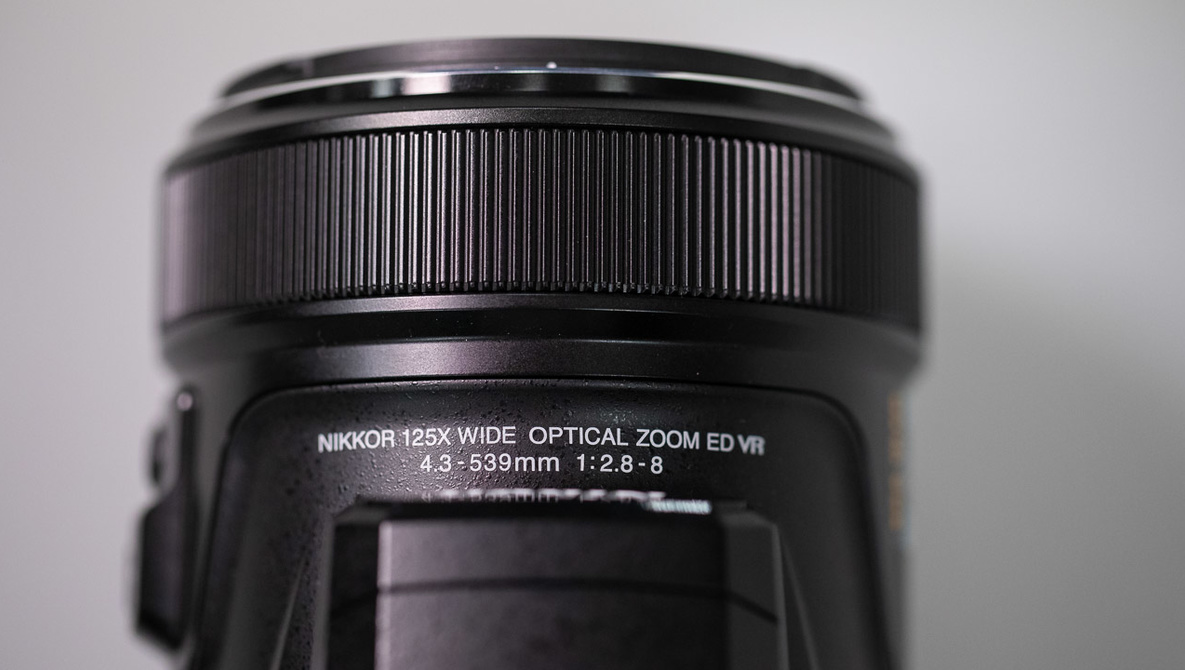
Back in 2018 Nikon released the Coolpix P1000, a super zoom bridge camera with an optical zoom of 125 times. No other camera has this optical zoom range. It could be an alternative for all those part time wildlife shooters. Or perhaps not?
I almost forgot about this camera that hit the market in September 2018, a little over one year ago. Nikon managed to produce a camera with all the zoom you would even need. And some more. Ranging from 24mm wide angle up to a whopping 3000mm super tele. When pointing at the moon, you could almost spot the Apollo 11 standing in the Sea of Tranquility.
Well, to be honest, that is impossible of course, but you do see a lot of details on the surface of the moon when zoomed in to its maximum reach.
This optical zoom is amazing, making things possible that were almost impossible. But is it usable? Well, I found out during the short time I spend with this large compact camera.
An Overview of the Coolpix P1000
The Nikon Coolpix P1000 has a 16 megapixel sensor that measures 1/2.3 inch. The lens ranges from 4.3mm up to 539 mm. If we compare this to a full frame sensor, it is equivalent to 24mm – 3000mm. The aperture varies from a nice f/2.8 to f/8 when zooming in.
This f/8 sounds a like a small aperture, but if you take the focal length into account, it isn’t that bad. Nevertheless, you have to realize this when using the camera during darker days, or in twilight. In a lot of occasions you might be in need of a high ISO value to keep a usable shutter speed.
When photographing handheld with a focal length of 3000mm, you should theoretically need a shutter speed of 1/3000 sec to prevent movement. But the Coolpix P1000 has amazing image stabilization that makes it possible to shoot hand held without any problems. The biggest problem I encountered when fully zoomed in, was to keep the subject in the frame. That turned out to be a real challenge.


The balance of the camera changes when you zoom in. The length of the zoom barrel is significant, and you feel a drag of gravity when you keep holding the camera in the same way when zoomed out. In a way, it is less convenient compared to a DSLR with a larger lens, although the Coolpix P1000 does weigh about one and a half kilograms.
The Controls of the Coolpix P1000
The Coolpix P1000 is a typical bridge camera, with the size of a medium sized DSLR camera like the Canon EOS 7D mark II. On it, you can find all the controls you would expect from a DSLR, and a wide range of buttons to access the most important settings.
The camera has a nice tilted screen that can pivot in every direction. There is no touchscreen functionality. The controls next to the screen are well placed and easy to reach. On top you find the different exposure settings and dials.
The menu is very rudimentary. There are not a lot of options to choose from, although it might be enough for this camera. You can make the most important settings. There is a possibility for an auto-ISO setting and although it is not mentioned, I presume it will take the focal length into account. Unfortunately ISO 1600 is the upper limit.
I ignored the communication functions and 4K film functions, and concentrated on photography. I used the auto ISO function, placed the camera in aperture priority, and chose to shoot raw images. I imagine most users would operate the camera in this, or a similar way.
Real Life Use of the Coolpix P1000
Besides shooting the example of the zoom capabilities, as shown with the photos of the moon, I went for a walk during morning twilight. I knew it would require some higher ISO values, since I did not bring a tripod with me. I hoped that wouldn’t be a problem, but unfortunately the performance of the Coolpix P1000 wasn’t as good as I expected. During twilight the camera used the maximum ISO value, which produced a lot of noise. Even with a post processing on the raw files, the noise levels were unacceptable at ISO 1600. The result can be seen in the before-after example below. You can switch between the original, and the post-processed image with a lot of noise reduction applied in post.


An hour after sunrise I stumbled upon some kingfishers at a nearby creek. I was excited to have a optical zoom range of 24-3000 mm available, making it possible to take pictures of these small birds from a nice distance. But unfortunately the quality of the photos turned out to be… well, I have to say unusable. There is a lack of detail due to the unacceptable noise levels, even though I shot raw photos.
It turned out the camera had used the highest possible ISO level, which is ISO 1600. The results are not even good enough for social media purposes.
When used with a lower ISO level, the result is reasonable, but not very good. Having seen the results, I decided to stop using the camera because it did produce the quality I want in my photos.
Conclusion
I was excited to use this camera for a while. And I was even more excited to stumble upon a pair of kingfishers, while having this enormous zoom lens available. It is something that you cannot find in a DSLR or ML camera.
I once used a Canon EF 800 mm f/5,6L, which is almost the maximum available for a relatively reasonable price. Even this monster of a lens does not come close to the focal length you have with the Coolpix P1000.
But be aware, the zoom range of the P1000 comes with a price: the results are not that great.
I know, it is the sensor size, together with the high ISO values I used for these photos, that is the big issue. At first I was surprised the camera has ISO 1600 as a limit, but now I know this is even beyond usable.
But the small sensor is necessary to reach the 3000mm focal length (full frame equivalent). And that is what this camera is about, to have the largest zoom range in the world; to break a record.
The Coolpix P1000 is a somewhat strange camera. It allows you to take pictures with a focal length that is nearly impossible for a full frame camera, while keeping it portable. But it will never replace any super zoom lens on a DSLR or ML camera. So I guess it is a camera for the enthusiastic photographer that wants to be able to zoom in a lot. On the other hand, the prize may not that attractive for those enthusiasts, especially with the lack of image quality I have seen.
What I Liked
- Amazing optical zoom range
- A programmable zoom switch on the side of the lens barrel
- Relatively small and light weight
- Shoots raw images
- 4K video (although not tried out)
- Titled screen
- Very good and usable image stabilization
What I Did Not Like
- Image quality is disappointing
- A lot of noise with ISO 400 and higher
- ISO 1600 is nearly unusable
- Not a lot of menu settings available (although perhaps enough for this camera)
What do you think of this camera? Would you consider using it for its zoom capabilities, despite the quality? I would love to hear your thoughts on this. Please let me know in the comments below.