

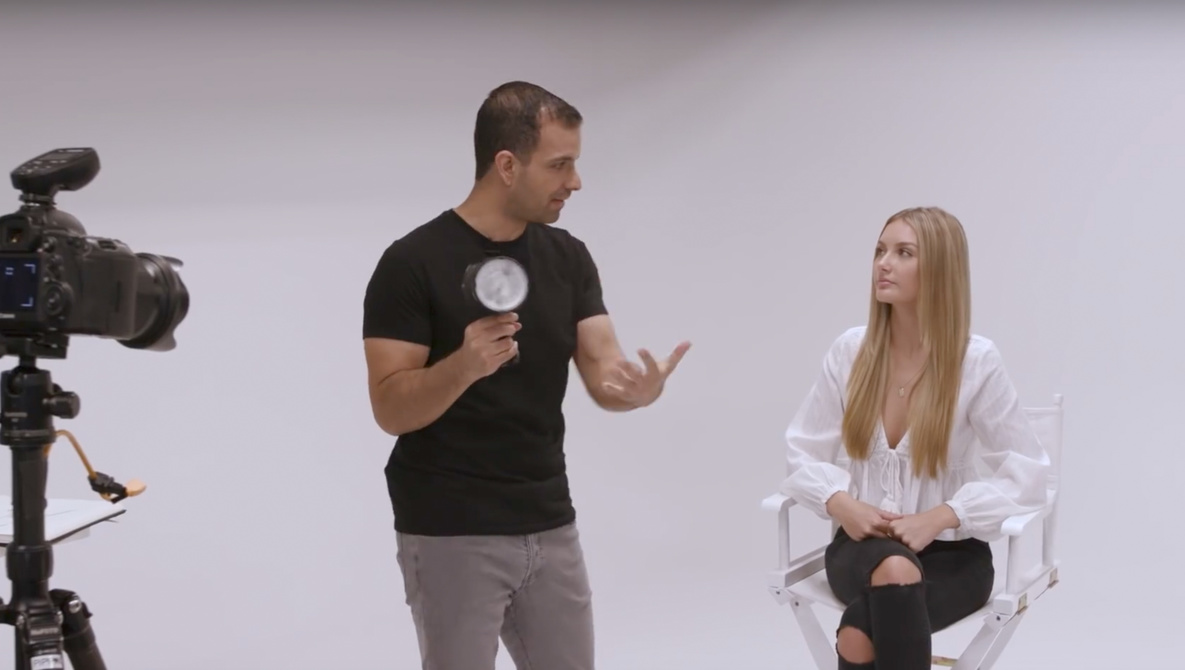
If you’re diving into using strobes for the first time or if you are still learning how to use additive lighting in your photography, then definitely check out these three misconceptions that many photographers have about shooting with flash.
Coming to you from Pye Jirsa of SLR Lounge and Adorama TV is a quick educational video on some of the biggest obstacles when tackling flash photography as a beginner. Pye does a great job of relaying how each of these issues works and the misconception behind the thought process versus the reality. Let’s dive into one of these explanations a little more in depth, and I’ll share how I learned to quantify the inverse square law in a way that may be more intuitive.
As the video explains, when we take a light that is a certain distance from the subject (for example let’s say one meter or about three feet) and pull the light back to double the distance (now at two meters or about six feet), the light that is hitting our subject is not halved but is actually reduced to a 1/4 of the amount of light. This is the inverse square law. This also works in a similar way if we take our light and move it closer to the subject (decrease the distance by half): we then have four times the amount of light on the subject. This is the explanation of the inverse square law that we are used to, but it’s not a great way to understand how light works in a real world scenario when we might want to change the lighting to actually be 1/2 as powerful instead of 1/4. This is why we should all know how our f-stops work, as they describe exactly how our light power works and it gives us our formula to use, too!
Let’s say I have a multiple light set-up where everything else is perfect, but my key light is metering at f/11 and I need it at f/8, a one-stop difference or half the power of f/11. If we move that light the current distance multiplied by 1.4 (as in f/1.0 to f/1.4 is one stop or half the amount of light), then you have brought that light down in power to f/8. If we needed the key light instead to be at f/5.6 then we would simply double the original distance (for example, f/1.0 to f/2.0 is two stops difference), and therefore, we’ve calculated that we would have to multiply the distance by two. We are in fact substituting our f-stop for the multiple of our original distance to quickly change the power of the light.
Next time, if you’re doing portraits outside, and your subject is a little too bright, then try pulling your light back by the original distance multiplied by 1.4. For example, if your original distance is 3 meters, then you will try to move your light back to about 4.2 meters from your subject. If you think more in terms of imperial measurement, then if your light is 10 feet from your subject you would multiply that distance by 1.4 and move the light to about 14 feet away from the subject. This will reduce the amount of light hitting your subject by one stop just like if you were closing down your aperture from f/1.0 to f/1.4.
Let us know if you learned a bit more about flash from Pye and Adorama from their video or if you’d like to add to the top things photographers get wrong about flash.