

There are many things in life you have a choice over, but your parents are not one of them! You are born and — to a greater or lesser extent — bred, shaping the person you are today. So have you looked at their photographs?
Everyone seems to be obsessed with family trees — knowing where they have come from says something about them and their family today. It’s a natural curiosity and one that has led me to investigate historic censuses, along with birth, marriage, and death certificates, leading me to an 1800s Methodist community in staunchly Catholic Ireland. It stirs powerful and emotive feelings because it can help us to understand what has shaped our family today and how we became the person we are.
Researching family trees naturally leads to our ancestors and so photos of them. The image below is of my paternal grandmother Sybil, taken in 1922 somewhere in London’s Hyde Park when she was 20 years old (the Smiths were sticklers for recording person, place, and date!). Given she was married in 1927, the photographer is unknown.

This is one of a smattering of images that pre-date my father’s own photographs. He’d always been a keen photographer, a result of his late 1940s high school having a darkroom and Leica (possibly a Leica III). However it wasn’t until his death that I inherited the large pile of loose photos that had lain undisturbed in an old box, slowly gathering dust. These photos then sat in the corner of my kitchen until recently, when I began the process of scanning some 600 prints of varying sizes.
What I discovered was a record of teenage self-discovery, with the camera the tool of choice. I’ve found the traces of a young man who was trying to make a record. trying to understand, the world around him, whilst experimenting with the technical vagaries of the photographic process that must have involved exposure, film stock, development, lighting, and printing. The number of photos remaining are limited, and whilst they detail who is in them, there is no further technical information. From this point onwards his archive shows how he developed in to an accomplished photographer who, in the 1950s post-war period of European rebuilding, showed where he went and what he did.
I’m proud of the images my father produced, however I know that that view is tinged with a degree of sentimentality. I’ve already talked about what makes a great photo, and with the distance of time, these images are already of immense interest just because of their age. As the older photos segue in to family images, they cease to be objects in and of themselves, morphing in to pseudo-memories where I impose an understanding of my family on to the events depicted.
Appreciating a photo graphically — its message — is very different from overlaying personal biases and in this sense I enjoy his earlier photos better. As a technical photographer myself, I also possibly better appreciate the hurdles required to accomplish the end results. Or maybe as we age as photographers, we run the risk of becoming lazy, becoming stale, losing our voice to visually describe and detail what we are seeing. So maybe he became lazy as time went on. That said, do we equate family photos with a lack of visual dynamism? Is it a subject area that we subconsciously value less as art?
Looking at my father’s archive, I realized that I was critiquing the earlier photos for their aesthetic, whilst viewing the later photos as family objects. The boy who became a man was a distant photographer I didn’t know, whilst the father I remembered fondly always had a camera to record family events. I needed to throw away my personal connections and view the work as a whole, appreciating it as a single body.
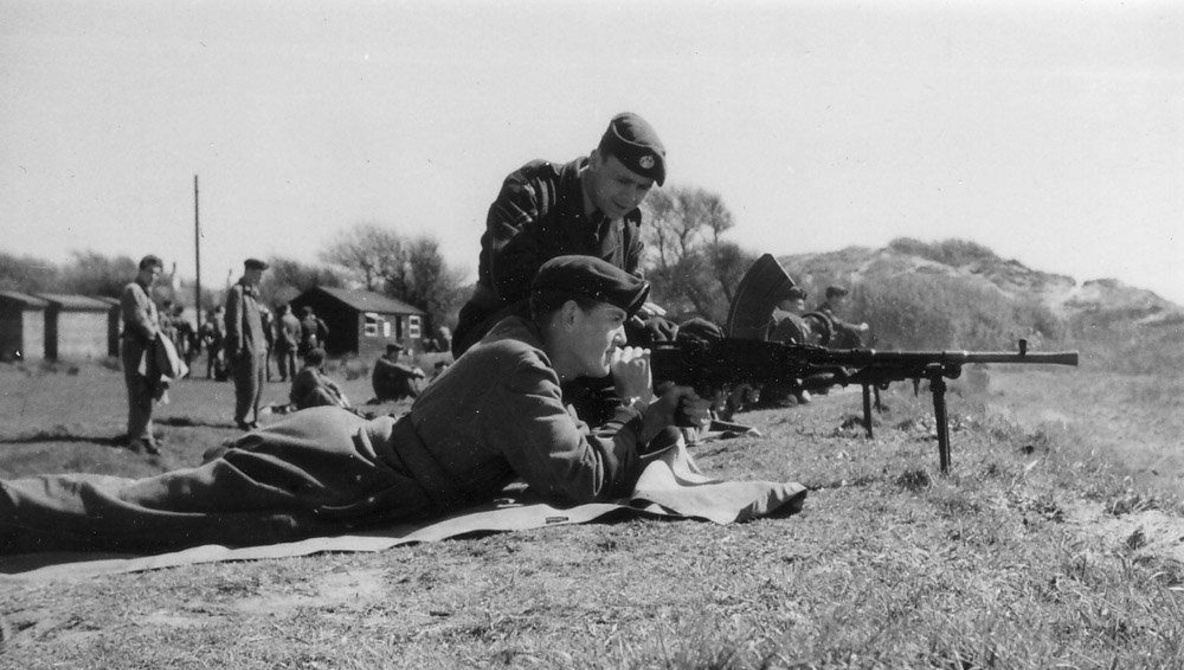
I’ve picked my favorite photos below which show the range of his work, but are all pre-family. There are images from is time in the Royal Air Force, portraits, travel images, and friends.
Strangely then, the photo I like best is of the silhouetted arches (below) which was taken on a family holiday. In a sense it is cliched, however rather than representing a metaphorical view on to the outside world — separating the viewer from the viewed — I think it does the opposite. The arches are representative of interconnectedness, of a world of parts, making us aware that what we are looking at is simply one facet of a bigger whole. It makes the image more expansive, rather than constrictive. I like it because it could be one of any hundred medieval cities, yet it shows us that there is one world, one whole.

What started out as a process of cataloguing photos that lay half-forgotten in the corner, turned into a journey of self-discovery. Discovery of who I am as a result of where my father came from, sharing his experiences through the eye of his camera. Discovery of who my father was through an understanding of what he photographed, why, and how. And discovery of the photographer I never really knew, appreciating his photos within the context of photography rather than family.
It’s also a reminder of the cycles of photography that many pass through. If you are a professional then you make and take photos as part of the job — you never really stop. However you can still fall in and out of love with photography — as art — and that is where personal projects play a part in reviving creativity and re-inspiring us during slumps. As amateurs, the modus operandi is different. There is no financial or career imperative, you take photos because you want to, because you like doing it. I think my father was drawn to photography from an interest in the technical requirements, gear acquisition syndrome, the excitement of a new career and travel, and the orderliness that you can impose on the world when making an image. Whilst he never stopped photographing, I don’t see the fresh creative joy that inspired his earlier work.
Perhaps my single biggest takeaway then is to stay in love, stay inspired, stay joyous in your work. So start the new year, planning how you might achieve this. However the best place to start is with your parents’ photos — what is your favorite and why?