

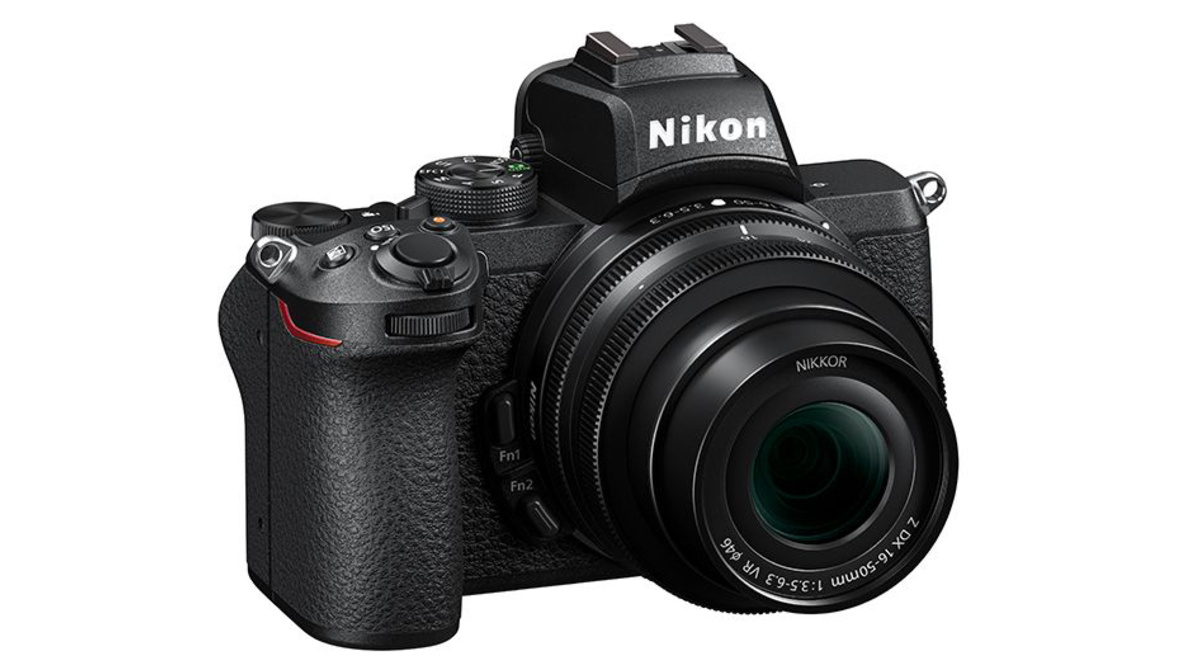
Nikon’s newly announced Z50 mirrorless camera may be one of the company’s most important announcements. With sales falling across the industry, product lines will need to consolidate, and the introduction of an entirely new line sets a very significant precedent. Nikon had strong performances in the DSLR era, with cameras like the D3, D300, and D700 as standouts, but were later to the game with significant mirrorless cameras. Is the Z50 the right direction?
The announcement for the Z50 shows the impact that a number of trends have had on the camera industry. The greater desire for video functionality, a selfie-focused mode for vlogging or photos, and support for transfer to smartphones are all a sign of the times. While some of these features have been present, in some form, in past Nikon cameras, they are now front and center. For a camera aimed at “those advancing from smartphone photography,” these all have to deliver.
Features?
Whether these features rise beyond the level of just existing will have to be determined. The current implementation of Snapbridge on my Z7 is fine, but certainly doesn’t align with the main selling points of that camera. On the lower-megapixel Z50, however, transfer speeds should feel better; while the greater emphasis on picture controls (Nikon’s JPEG styling) shows they aren’t expecting heavy raw use. The selfie mode, which locks out everything but the shutter button to avoid accidental presses, is a nice inclusion.
Speaking of buttons, the smaller body doesn’t sacrifice many compared to the larger Z7 and Z6. Importantly, both the front function buttons remain, although the back-button layout has been simplified. I’ve felt that this was one of Nikon’s biggest problems with past DX DSLRs, where control layouts changed arbitrarily between the different levels of gear. 
Unfortunately, while many features feel full-bodied in their implementation, including full sensor 4K video, the body does lack IBIS. While many APS-C mirrorless cameras don’t offer this, I loved the implementation on the Z7, and feel like this would have been a good way to stand out from the pack.
Sins of the Past
One of the biggest mistakes, in my opinion, from Nikon’s DX DSLR era was the lack of rational lens options. While they had about 40 flavors of 18mm-to-something zooms, there were few good options for their higher-end bodies. It was particularly egregious when it came to primes.
Looking at their new lens roadmap for the Z mount, I’ve got good feelings. As a Z7 user, I’m excited to see a number of great options across the range. Looking at it from the perspective of a Z50 user, I see at least some indication that Nikon is approaching the lineup with more thought. The also-announced 16-50mm and 50-250mm seems like great pairings. Even the 18-140mm was to be expected, as I remember Nikon and many users loved the 18-200mm in the DSLR era.
The 16-50mm kit lens is impressively small. While DX has had small lenses in the past, this seems to be the same leap forward that the Z 24-70mm was.
Importantly, they are promising “compact prime lenses” at 28 and 40mm, as well as a 60mm macro. These lenses aren’t DX or S-Line (Nikon’s indication of top quality and price), making them great “grow up with the user” options for DX and a good small lens choice for Z6 and Z7 use.
A couple months ago, I mentioned how I was disappointed with Nikon’s pace and choice of lens introductions for the Z line. Given the new roadmap, I’m happy to say I’m feeling quite differently about things.
A Source of Concern
While Nikon seems to be hitting many of the right notes with the Z50 and the broader Z lineup, I still have some concerns. Is it too little, too late? Will Nikon’s marketing make users aware of the benefits of the Z50 over their cellphone? Is a 20-megapixel sensor going to impress consumers in the age of 64-megapixel phones (even if photographers know the difference)?
The Z50 makes a compelling option for D7500 users, offering the easy transition into mirrorless that the Z7 offered to D800 users. But APS-C mirrorless has been a hotly contested market, and it remains to be seen how many of those users that would have upgraded haven’t already left for other brands.
Against the broader market, Nikon’s pricing strategy could make or break the camera. The Z7 and Z6 received aggressive promotions, including large trade in bonuses and free FTZ adaptors. With the one-lens kit at a retail price of just under $1,000 before any promotions, it feels pricey. At that point, it feels too expensive for a first camera, while lacking some “must-have” features for DSLR equivalent users upgrading from bodies like the D5000 or D7000 series.
I’ll be curious to see how pricing shakes out over the next couple months. At the current point, Fuji’s aggressive discounts put a number of bodies in contention, while older Sony full frame bodies are only a few hundred more.
The Future
As things stand, buying this feels like making a bet on the future of the Z line. By buying in, you’re committing to building a collection of lenses and comfort with the controls that should scale into the excellent full-frame Z bodies — at the expense of current value. You can see full frame in the future, but might still be shooting an APS-C DSLR right now, which makes Fujifilm’s APS-C to medium format gap unappealing. Canon’s disjointed mirrorless lens situation, where RF and M mounts are incompatible, looks shortsighted in comparison.
If you’re an existing Nikon DSLR user, particularly of an older generation body, this might be a great upgrade point. If NIkon offers the same strong trade-in incentives, you could upgrade for less money than you’d expect. Moving to a more future-ready mount and getting access to the generational improvements of focus and sensor updates should both be part of the value equation. Lastly, while the size disparity isn’t nearly as dramatic as FX to Z7 and Z6, it still is an improvement.
It also feels like Nikon trying to show that they’ve listened. There feel like fewer arbitrary feature reductions compared to past DX DSLRs, with new features implemented with an eye towards how people are using their cameras these days. While this camera signifies Nikon has entered the APS-C mirrorless fight, it’s their next salvo (a hypothetical Z60 meant to bring D500/D7200 users over) that will really be important.
Lastly, I think the other announcements from Nikon are just as important. New lenses across the Z line should be appealing to Z6 and Z7 users, while being an important indicator of their continued support for the platform. Also, the absurd 58 f/0.95 is finally out, allowing for the redeployment of whatever staff were working on it to more useful projects.
Is the Z50 going to be a wild sales success? No. The APS-C market is too crowded and competitive for really any option to blow off the doors. Instead, I think it can be a success as part of the broader Z ecosystem, which I’ve grown very fond of. By delivering enough features to appeal to DSLR users and adapting adequately to contemporary trends in an appeal to smartphone photographers and videographers, the Z50 shows Nikon is serious.