

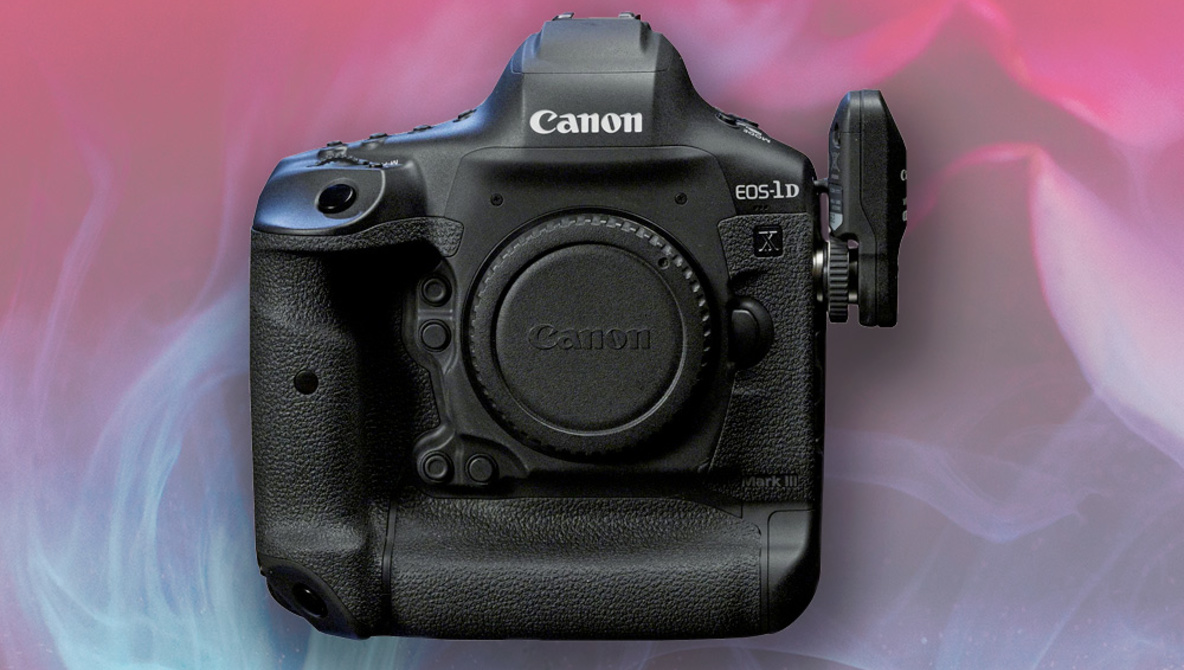
Canon’s announcement of the 1D X Mark III has inevitably set the camera world chattering, confirming some rumors (raw video) and debunking others (there is no new battery with a secret new feature). Among the specifications, it’s interesting to see what’s been left out and how this compares to Nikon’s own “announcement” last month, not to mention the Sony a9 II.
Canon has revealed some truly impressive features on its forthcoming sports and wildlife flagship: 16 frames per second with autofocus tracking with the mirror, 20 frames per second with autofocus tracking with the mechanical shutter in Live View (i.e., no mirror), dual CFexpress cards, a rather remarkable internal 4K 10 bit 4:2:2 video with C-Log, and internal raw video as well.
Ominous Omissions?
What’s notable, however, is what has been omitted: there’s a brand new sensor, but no mention of how many megapixels it will feature. Only a few years ago, this would have been one of the headlines; today, by contrast, it’s a detail that’s seems lost among frame rates and video specifications. If Canon isn’t shouting about the number of megapixels at this early stage, it seems reasonable to assume that there will be little or no increase over the 20.2 megapixels of the 1D X Mark II, especially when Canon made a lot of noise in 2016 about the two-megapixel increase that camera brought over its predecessor. Furthermore, the rumor sites felt confident that the Mark III would offer a “significant jump” in resolution, so it will be interesting to see how this plays out.
In fairness, more megapixels is not an aspect clamored for by prospective buyers. Press, sports, and wildlife shooters are typically looking for speed, not resolution, and while it may not quite match the 24.2 megapixels of the recently announced Sony a9 II, it’s probably not a major concern.
The new video specifications are impressive and pretty much in line with what was expected, although for all of the chatter over the last couple of months, uncropped 6K is not listed. Some other headline features touted by the rumor sites are markedly absent from this announcement: Canon has not mentioned IBIS, an omission that would seem like an odd choice given the 4K 10 bit 4:2:2 and raw recording capabilities. Surely, there is space within this huge body to add stabilization, and given that Canon is wedging in such impressive video specifications in a camera that’s engineered first and foremost as a machine for stills, it seems incongruous. If you’ve any insights as to why Canon may have chosen to leave it out, leave a comment below.
Remove the Mirror?
As expected, this is a DSLR that is trying to take as much from mirrorless cameras as possible. Stepping back from the detail of this announcement and looking more broadly, the technology is at a strange juncture where, arguably, this camera would be improved by simply removing the mirror completely and adding an EVF. If the Live View outperforms the optical, what is that mirror for other than to keep users trapped with an outdated optical viewfinder? As it stands, if you want the best performance from this camera, you have to hold it at arm’s length and stare at the rear LCD. Is this not a little bit absurd?
Of course, it’s not that simple, but you have to wonder if we will look back in 10 years and see the last of the DSLR flagships as being these weird hybrids of different eras of technology. Canon is doing its best to navigate the transition towards mirrorless, but you do have to wonder what this mirror is for other than to hold this camera back. Would a hybrid viewfinder have been a solution here? Is there enough demand to warrant the research and development involved?
Technological Titillation
Canon is being seductively cryptic with the news over its new autofocus button that is touted to have entirely new features. What will that be? As revealed in BHPhoto’s video (see 0:34), the button is a slightly different design. One suggestion was that it might function as a joystick that combines the AF point selection, but this seems unlikely given the presence of a joystick just below it, so I’m wondering if it might be a two-stage button that allows some sort of triggering of the new “deep learning” that Canon has teased us with in this announcement. Your thoughts in the comments, please.

So, is Canon being deliberately selective with the information that it’s putting out because some of the specifications are not what was expected, or are some of the groundbreaking features being kept under wraps to create some more headlines a bit nearer the time? It wouldn’t be surprising if Canon decided to make a deliberately partial announcement following the news of the Sony a9 II and Nikon’s “announcement” of the D6 back in September. Nikon declared that its new flagship would be its “most advanced DSLR to date,” but bizarrely, kept all of the specifications secret, perhaps slightly concerned that Sony was about to make its flagship camera feel somewhat underwhelming.
Whatever the outcome, it feels that while Sony has led the way in frame rates and autofocus performance, Canon is still offering good reasons for agencies and those pros heavily invested in Canon glass to stick with them for the foreseeable future. If you shoot under pulsing lights, the Canon makes the most sense given that its mechanical shutter now flies around at 20 frames per second. Mechanically, that is ridiculous, and while Sony — who can only make shutters move at 10 frames per second — should be respected for its innovations in sensor technology, Canon should be given some serious kudos for making this possible. To a degree, the ball is now back in Sony’s court for the creation of a global shutter to make that mechanical shutter completely obsolete, but until that happens, good old analog technology still holds an edge over its digital counterpart.
If you have any thoughts on what Canon might be up to in terms of the specifications revealed and those that are potentially being kept secret, be sure to leave a comment below.