

If someone indignantly snorts that your image has been Photoshopped, it’s a rather unsubtle way of them telling you they think your image is fake. But really, aren’t all our images to a certain degree?
Photoshop has become such a common part of our everyday vernacular that it’s morphed its way into becoming a verb, much like Google. When you want some quick information, you “Google it,” and when someone wants to tell you in no uncertain terms that they doubt the legitimacy of your image, they tell you it’s been “Photoshopped.” Even my dear old mum, who, at 73, doesn’t actually know what Photoshop is, nor what it does, is never afraid of telling me “I like it Iain, but you’ve Photoshopped it, haven’t you?” When I try to tell her that Photoshop (or other similar software) is to modern photography what a grease and oil change is to a mechanic, her eyes glaze over and she starts playing with the dog again. Her dismissal of my futile pleas are along the lines that it’s cheating to use Photoshop and doing so is somehow not real, and therefore not worthy of her full attention or admiration. But this got me thinking, and I have to ask the question, has the finished image of a photographer ever been real? Or has it always been fake?
Was Ansel Adams’ Work Fake?
Let’s go into one of, if not the most famous photographer across the decades, Ansel Adams. His name pops up in every corner of the globe whenever you hear a photographer talking about their influences, or inspirational heroes. Herein lies our first issue with the debate over what’s real, and what’s not. Now forgive me if I’m wrong, but I’m pretty sure that Ansel Adams didn’t see the world, literally, in black and white. I mean, I know of people who are colorblind and don’t see colors the way most people see them, but I’ve never heard of a person, much less Ansel Adams, seeing the world through grayscale glasses. But aren’t Ansel Adams’ most famous works in black and white, like this image below?
 This image is “The Tetons and the Snake River,” taken in 1942, and I’m going to hazard a guess and say that this isn’t how Ansel Adams saw it with his own eyes, at the time he took this shot. Of course, the natural response to that might be that color wasn’t available back in his day and he was only able to work with black and white. In fact, color film became available in the 1930s, so it might well have been available to Adams. I can’t be sure, but perhaps it was his deliberate choice to develop his images in black and white?
Adams was known for his incredible ability to work with shadows, blacks, whites, and highlights when he was developing an image. He was the darkroom equivalent of a modern day Photoshop wizard, if you will. So the upshot of it all is that Ansel Adams’ images were black and white, even though the original scene he saw was in color. And he pushed and pulled the contrasts and lights and darks better than almost anyone else to get his signature look, even though he might well have had access to color film options. Surely, then, under the criteria of “real” used by my mum (and those of many other non-photographers), you’d have to say Ansel Adams’ work was fake, wouldn’t you, as painful as that is to even utter?
Is Long Exposure Photography Fake?
Modern cameras and equipment help us to do incredible things. One of my favorites is long exposure photography. It’s not to everyone’s taste, and as you might expect, my dear old mum hates it, but I fell in love with the dreamy, wispy clouds and the ghostly appearance of water the first time I saw it. Since then, whenever I go to waterfalls or see interesting patterns in the sky, the first thing I check in my camera bag is my Lee Filters Big Stopper. There’s nothing I find more enjoyable than setting my camera to Bulb mode and then opening up the shutter for minutes and waiting patiently for that ethereal smoothness to find its way onto my screen. This image below gives you an idea about the effect long exposures can have on moving things such as clouds.

But we have to ask the question again: is it real? The clouds didn’t look like that when I was at this location. And the scene certainly wasn’t black and white. I mean, I was there, and this is just one, single exposure and not a composite or anything, but it’s not what I saw with my own eyes at the time. Does that automatically make it fake? Does that mean if I set the shutter speed to 1/1000th of a second and took a quick snapshot, it would be more real than if I used the same camera and the same lens, but simply opened up the shutter to a minute, or longer? Does the introduction of a filter automatically expel me from the real club and banish me into the hellfire of the fakers?
Is Panning Fake, Too?
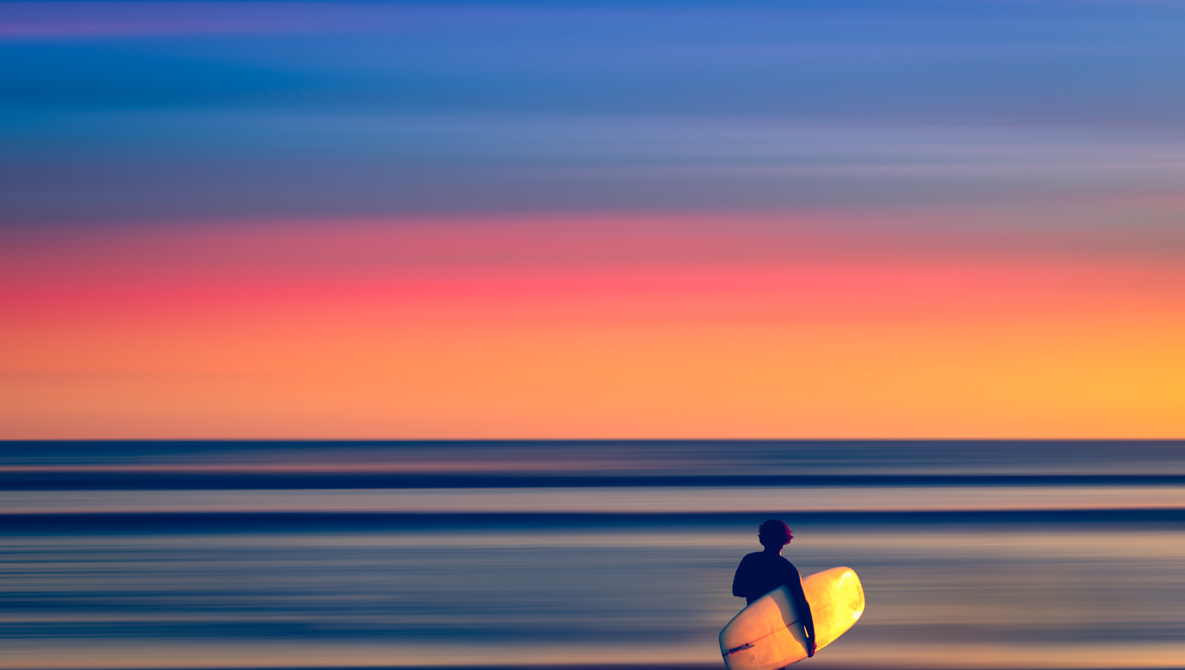
So now we come to some other interesting conundrums. I love the effect of panning, where you open the shutter to something like 1/10th of a second and then intentionally move your camera from side to side (or whatever direction you please) so that you get blurry, streaky lines from the scene in front of you. Much like the effect of long exposure photography, I love the soft, smooth, flowing lines that panning can give you. For a better idea of what I’m talking about, check out this image below.

But is it real? I mean the issue here is that if I stood perfectly still and shot the scene in front of me with a shutter speed of, say, 1/200th of a second and then uploaded it to Instagram and used the hashtag #nofilter, then people would most likely accept it as real. But if I stand in the same position, with the same camera, and the same lens, yet just slow down the shutter speed and swivel my hips in a groovy, disco, side to side fashion and get my smooth, streaky panning lines, I have to accept that it’s no longer classified as real? And Lord heaven help me here because as you can see, I’ve actually added a surfer into the scene to really muddy the waters. Panning and blending? Banish me to eternal purgatory now. Watch me double down.

I now have the golden trifecta: panning, blending, and black and white. Of course, I’m not trying to pass this off as “real” but where do you draw the line? Both of these shots (of sea and surfer) were taken seconds apart, with the same camera, the same lens, and with my feet barely changing position. This guy was holding his board like that and he was entering the ocean before him. I just used a bit of camera movement and Photoshop to present a different take. Does different take equal fake, and who sets the criteria?
Summing Up
To me, all art, including photography, is about creativity, imagination, and producing something that your mind’s eye sees, or what your client wants. I don’t care if someone says something’s fake or not, or if they think something’s been “Photoshopped” because I have no limits. As long as we are honest if someone asks us about how we created an image, what does it matter? As long as I like my finished images and they represent accurately my feelings and my artistic ambitions, then I am happy. And it seems others feel the same way, judging by some comments on my Instagram feed when I uploaded this black and white image you see above.
 However, it seems to some people that any image not accurately representing exactly what we saw with our very own eyes at the precise time we hit that shutter button must be fake. So any black and white image is fake, any retouched image is fake, anything with even the slightest bit of change, no matter how infinitesimal, is fake. Or is it? Is there a line that’s acceptable as real, even though it’s not actually real?
Please leave your thoughts in the comments below.