

Depth of Field, or a lack thereof, has become a buzzword of sorts in photography circles. Many times the term is used as a blanket nomenclature to cover anything to do with how much or little of a subject is in focus. What we often fail to consider is why. Why are we choosing to use as much or as little depth as we do? It’s time to look past aesthetics and really think about depth of field in relation to our subjects.
What is Depth of Field?
Depth of field is a measurement. It’s a definable distance. It is the total region of “acceptable” focus around a given point. If your autofocus locks on to a point, that point is not the only distance of acceptable focus. Depending on a variety of factors, there is a certain distance both in front and behind that point that yields adequate focus. As your aperture gets smaller, that distance becomes greater and greater, all other factors remaining equal. The distance from your subject, focal length, and sensor or film size also all come into play in calculating your total depth of field. But, how does that help us as portrait photographers?
Using Depth of Field as a Tool
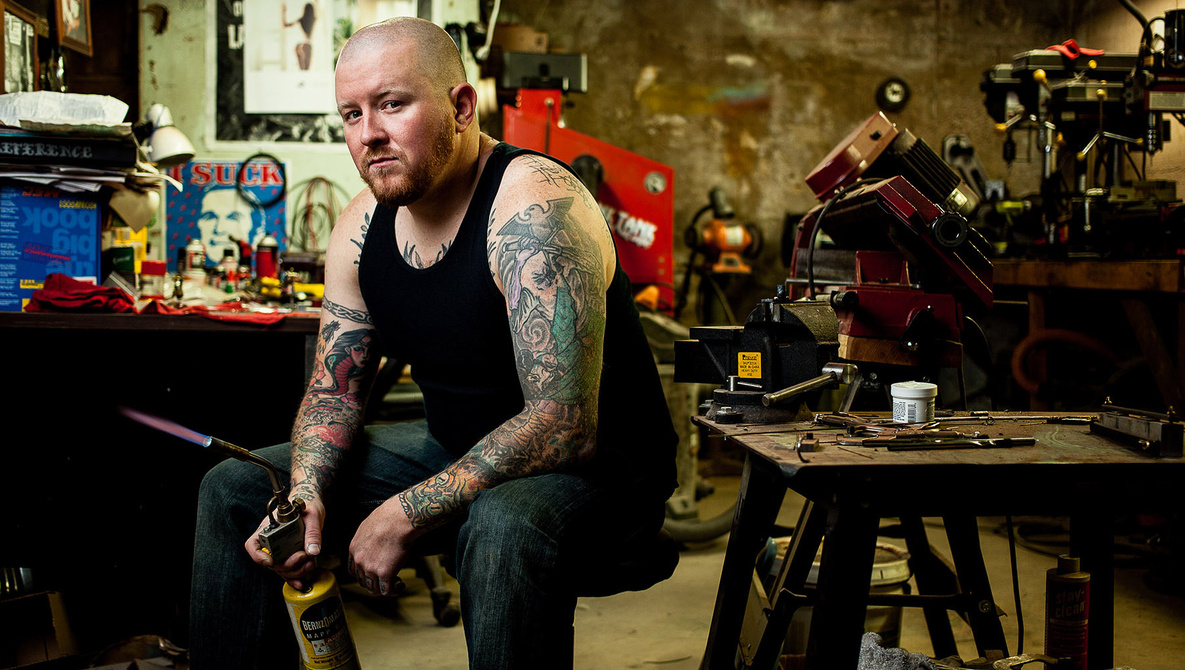
Because we know that depth of field is a clear, definable number, we can use it as a reliable tool. Say I’m on assignment and need to do a portrait of someone in a very tight space that isn’t conducive to the look I want. I probably want to eliminate as much of that background as possible. By knowing how much of that background is in focus ahead of time, I can begin to make decisions about which lens I want to use, what aperture I want to shoot at, and how much of my subject I want in the frame. Too many times, we grab a lens because we like it and not because it’s the best for the job. If you’re shooting in an opulent ballroom and want to get as much of the room in the photo as possible, why are you shooting at f/1.4? Environmental portraits that completely ignore the environment have become a bit of a plague with photographers. I bet I know why.
The “Bokeh” Trap
The term bokeh, aka the word that won’t die, has become ubiquitous in the portrait community. I’ve made no secret of my ambivalence for it in the past. However, depth of field goes far beyond bokeh. What is bokeh? Thousands upon thousands of articles across the interwebs have been devoted to it, but, in essence, it’s the quality of the out of focus area of a photograph. Bokeh is not depth of field. Bokeh has probably made lens manufacturers more money than sharpness ever could. It’s also caused many, myself included, to create photographs that didn’t utilize nearly as much of the environment as they should have. Bokeh, in the grand scheme, is trivial. Depth of field, on the other hand, can truly make or break a photo. If you photograph a bridal party and the “bokeh balls” have a cats-eye shape, 99.9% of people won’t notice or care. If half the groomsmen are out of focus, someone is going to be pissed. There’s nothing wrong with appreciating bokeh. Just don’t let your love for it screw up your priorities.
Subject Separation: Don’t Be a One Trick Pony
When you ask a photographer why they’re using a shallow depth of field, more than likely the answer will be subject separation. They need to separate the subject from the background to make clear what or who the photo is all about. That’s a totally valid answer. Just make sure that it’s not to the detriment of the rest of the image. There are many ways to achieve subject separation. You can light the subject. You can use the surroundings in an interesting way. The composition can draw the eye where you want it. The answer to “How do I isolate my subject?” isn’t always “use shallow depth of field.” You’re better than that. Think about your options before you habitually break out that 85mm and lose the scene.
The Best Tool For Nailing Your Depth of Field
During the time of manual focus lenses, most lenses came equipped with scales to easily read the depth of your shot at a given aperture and focus. Although many lenses do still have distance scales, most are so small or general that they are basically useless. My favorite way to check my depth of field is with an app! There are a few apps on both iOS and Android that will quickly and easily give you your depth of field. If you don’t want to use an app, you can find a great website here. Just enter in some approximate distances, the focal length of the lens you’re using, and your sensor size and it’ll spit out your depth of field. For example, you’re shooting a corporate group photo. You can guestimate that you need to cover about 3 feet of depth between the front and back rows of people. You plug in the numbers and the app tells you that at your current f/4 setting your depth is 2 feet. You know that you need to stop down, move back, or switch lenses. Simple. Your LCD will lie to you. You’ll be in a rush and think you’ve got the shot when you don’t. That’s what makes depth of field so handy. It doesn’t lie. Bokeh is subjective. Focus is not.
Knowing your depth of field can also reveal flaws in your technique. If according to the numbers your subject should be in acceptable focus and it isn’t, something else could be wrong. What you think is missed focus could be motion blur. Perhaps you need to get on a tripod. A lot of photographers think they can hand-hold a shot when they’re not nearly as stable as they think they are. I know that as I’ve gotten a bit older, I need to reach for my tripod more and more often. There’s no shame in it. Get the shot. Don’t worry about your ego.
Do any of you have tips for managing depth of field? We’d love to hear them!