

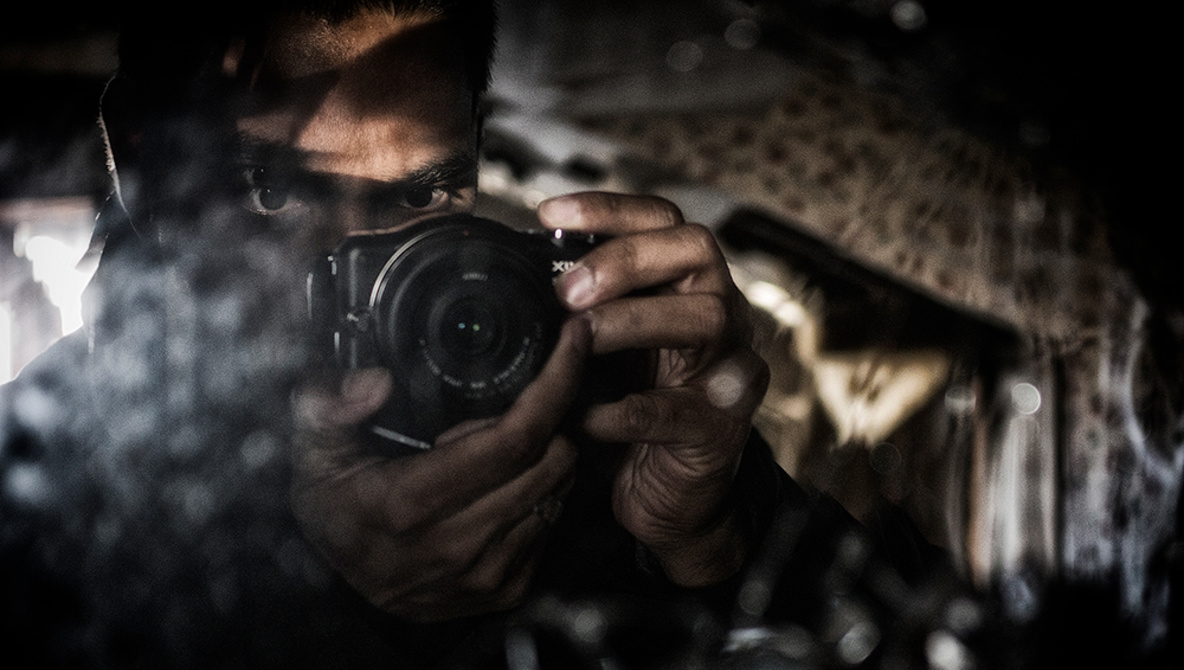
Being a photographer with a “real” camera always carries risk. People well within their rights to photograph in public are harassed online all the time. I’d argue, though, that being a brown person in the United States adds an extra layer of risk that other photographers don’t face, namely fears that you’re a terrorist taking photographs to plan for a future attack.
If it was just one time and one story, I wouldn’t say that. But it’s definitely not just one time. I’ll start with a story of my time as a graduate student, where I took this photo:
The photo was taken from the top of the Syracuse University’s Crouse-Hinds Hall, in a hallway in the building that houses classrooms and administrative offices. No one is barred access to any of the hallway and classroom areas during business hours, so I took the elevator up to the eighth floor and placed my camera against a window overlooking the campus. I was aiming for a time-lapse.
Ten minutes pass, and a janitor walks past, but no one else. Ten minutes later, an officer from the Department of Public Safety walks up and informs me that only faculty and staff are allowed up in the hallway. I knew where this was going, but I gamely showed him my ID anyway, since I was adjunct faculty even before I was a graduate student. My ID card said as much. He seemed to short-circuit, fumbling through some words about how someone reported a suspicious person in the hallway and that I needed to leave.
Like I do in any interaction with police officers, I pondered whether I should challenge the assertion that I was a suspicious person, but I determined that I already had the photo I wanted and that the better play was to back down. I packed up and walked away.
Another time, when flying out from Buffalo Niagara International Airport with camera gear I needed to shoot a wedding, I got stopped and searched six ways to Sunday when going through the security checkpoint. That was not unexpected, given the amount of hardware I was packing. What was unexpected, was that after I had packed everything back up and put my belt back on, was that I was stopped and searched again in the same manner after walking five feet away from where I had previously been searched, without explanation. I complied, again. That said, I’ve been “randomly” searched most times I’ve been through the airport, gear or not.
When Taking Photos Is Really (Not) Encouraged
Sometimes, the stories just cross into the territory of asinine. Take this example from the Destiny USA Mall in Syracuse:
The tweet does most of the talking, but in short, I had my Fujifilm X-T1 with the XF 35mm lens (a diminutive setup as far as cameras go), and I was still stopped by mall employees and told to stop shooting. There’s a picture of a DSLR right on the sign, for crying out loud.
All of that brings me to the most recent incident from just this previous week, where I photographed a fixture in Bridgeport that I’ve photographed numerous times before, a power plant by the water.
I ride this ferry to work every day, many times taking photos, without incident. On weekends, there are parents, mostly not minorities, riding the ferry and taking pictures left and right. In the case of the photos above, I was using a 14-year-old Canon Rebel XTi, a camera that arguably takes worse quality photos than the Google Pixel 3a XL in my pocket. To make it a point, I started photographing with my cell phone first for a few minutes before switching to my DSLR. That was when I was asked by a ferry employee to stop and to not take photos. After I pointed out that people take plenty of photos with their cell phones, she relented and told me to not take photos of the (very visible from all angles everywhere) power plant. There didn’t seem to really be any rhyme or reason to any of it. If I was trying to be sneaky to get photos of the plant to blow it up later, I’d use something a little less conspicuous than a silver DSLR. Or I’d just use Google Maps. It’s not really a secret power plant.
Either way, as the ferry is a private business, I complied with the request to put the camera away, but if you look at the photos above, can you even tell which one was a cell phone and which a DSLR? I’d argue you can glean the same information out of either photo.
Am I Being Singled Out?
Maybe I’m making a big deal out of what may be isolated incidents and individual people. There’s no way I’d know without A/B testing, since I only have the skin I have. But all of it adds up and wears me down over the years. While race isn’t mentioned in the article where Hilary Duff confronts a black photographer for photographing her kids, the encounter is dripping with racist undertones. Brown and black folks will understand exactly what’s going on here. The photographer didn’t look like the other people on the soccer field and was then singled out by Duff for scrutiny. It’s doubtful he’d get the same treatment if he was white.
I can’t be the only photographer of color to have experienced this. Have you? Leave your thoughts in the comments below.