

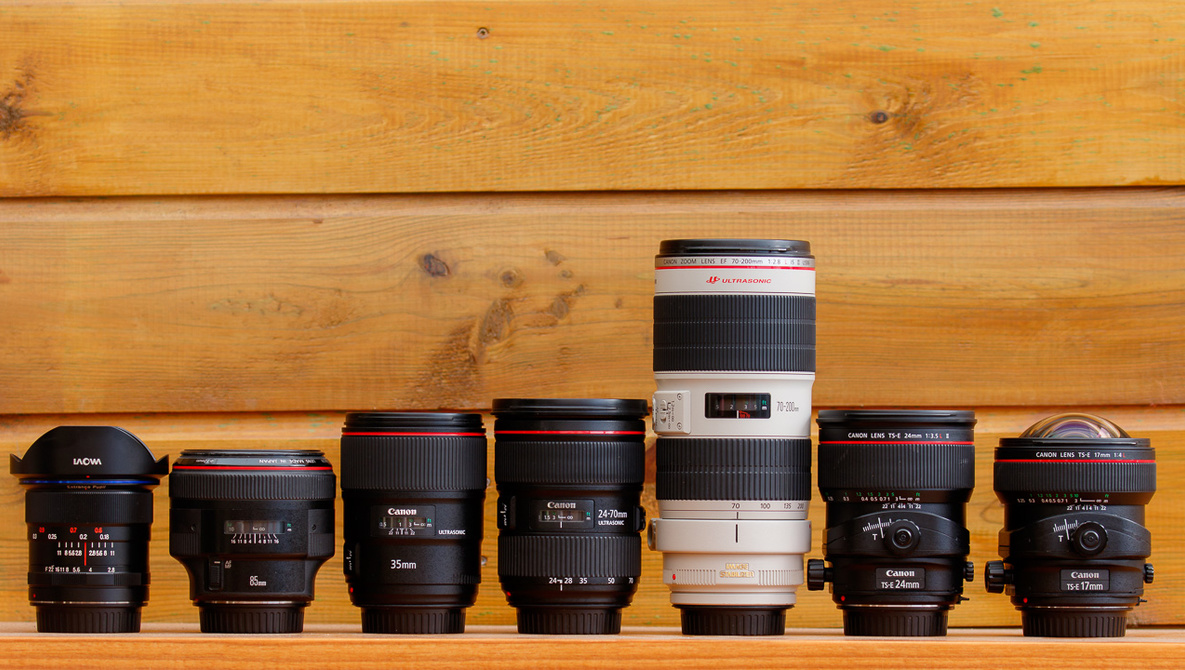
Often you get one lens included when buying a camera. But what if you want another one, which one do you need to buy? This article may be of help when choosing the best lenses for your photography.
When you start with photography, the camera you choose often comes with a single zoom lens. This lens is usable for regular photography. It is perfect for your holiday, children, a landscape, or your pet. But when you start to grow a preference for some kind of subject, that one lens often is limiting the possibilities. That is when you start searching for a second lens, or a replacement. It may be very difficult deciding what to choose, because there are a lot of different lenses available.
Some lenses are cheap, others will break the bank. You could spend a fortune on lenses, and probably still miss the one you really need. Looking at the second hand market learn how a lot of lenses are sold because it never left the bag. That is why I wrote this article with a basic lens choice for different types of photography.
First of all, only buy a lens because you need it, not because you might need it. And don’t buy too many lenses, because you probably will use only a few. Having a lot to choose from is also difficult. This article shows nothing more than a starting point. The combinations are my own personal choice, based on my experience. After you get more experienced in the discipline, you will find out what alternative you may need, or from which extra lens you would have benefit.
Although most of the images are of Canon equipment, this article is not about camera brand, lens brand, or other discussions on what is good and what is better. The lenses I show are just an example, concerning focal length and zoom range. For every brand there is a similar lens available, in the original brand of your camera, or a third party lens. Use whatever you like.
Be careful not to buy every lens you can get your hands on. Often it is not needed to have all focal lengths in your bag. Don’t get the disease called GAS (Gear Acquire Syndrome), because it only makes you suffer from having too much choice, and a backpack that is much too heavy.
Landscapes
For landscapes you would like to have the ability to capture a wide scenery, or details in the landscape. A wide angle in the range from 16-35mm is a great choice, but make sure you also have something like a 70-200mm lens available. These don’t need to have a f/2.8 aperture; often f/4 is sufficient. But if you want to use these lenses indoors also, f/2.8 or larger may come in handy.
Eventually you might want to have an even wider lens, if that kind of landscapes has your preference. Something like a 12mm ultra wide angle would be a great extension to this kit.
Alternatives for the 70-200mm can be a 70-300mm lens, or a 100-400mm, and you might think of a 24-70mm lens if you don’t like the extreme wide angle images.
Portraits and Wedding
I prefer primes for my weddings and can shoot nearly everything with this wonderful set of lenses. It is also perfect for portraits and model photography. The large aperture makes a beautiful shallow depth of field possible, although you don’t need to use that time and time again. Because these lenses are light sensitive, they also perform very well in dimly lit venues
You might want to extend your set with a 135mm lens, or even a 200mm, in case you need to shoot from a distance. You also want to prevent having too much primes available, because it can force you to change lenses a lot.
If you don’t like primes, a 24-70mm and 70-200mm will be the lenses to go for. And preferably with an aperture of f/2.8 if possible. Not only for the shallow depth of field, but also for dimly lit venues.
Architecture and Real Estate
For real estate I prefer the tilt shift lenses. They provide the possibility to do perspective correction on the location. Often you don’t need more than these two focal lengths and there is always the possibility to crop afterwards in post. If 17mm still is not enough, you can make a panorama using the shift option.
If you want to shoot some details, a 50mm tilt shift can help, but you can use a 24-70mm lens also. If you prefer having a normal lens, a 16-35mm lens may be the only lens you need to have. It don’t have to be f/2.8 because a large depth of field is almost always needed.
Stars and Milky Way
For stars and Milky Way photography an extreme wide angle may be the first lens you would want to use. It also enables you to shoot relatively long exposures without the risk of star trails. A large aperture helps capturing the maximum amount of light.
Eventually you might like a 24mm or 35mm prime lens. Often these have a maximum aperture of f/1.4, which allows a lot of light to enter the lens, and you can even turn one stop down to get more sharpness. The focal length can help capturing the core of the Milky Way in more detail.
There are a lot of alternatives, like fisheye lenses and other extreme wide angle. Fixed focus lenses may have some preference for the benefit of having large apertures.
Sports
I don’t shoot sports, but I have done so on occasion. I find the 70-200mm a very nice all-round lens for this kind of photography, and a 24-70mm can be of benefit when you are able to get close by. The large aperture helps getting a fast shutter speed and prevents an ISO value that is too high.
I can imagine you need more focal length on occasion. In that case I would think of a 300mm or 400mm lens with the largest aperture available, or affordable. And perhaps a 16-35mm when you want to get very close.
An alternative can be a 70-300mm, 100-400mm, of 150-600mm lens, although you might end up with the need for high ISO values. The maximum aperture of these lenses is often limited to f/5.6 or smaller.
Wildlife and Birds
If you love to shoot animals with a camera, you need a long lens. The first I would choose is a 100-400mm lens, which is a very versatile focal range. I would combine this with a 24-70mm lens for those occasions you want to capture the animal with its surroundings, which I love to do. If you have the money, you could add a 600mm lens to your set. But a tele converter can help also.
An alternative could be a lens similar in reach, like a 70-300 or a 150-600mm lens. Perhaps a 300mm prime would do perfect, although you could mis the zoom ability.
There are much more disciplines of photography, of course. If you would have to make a choice for only two lenses for your photography, which would it be and why? Please share this in the comments below.