

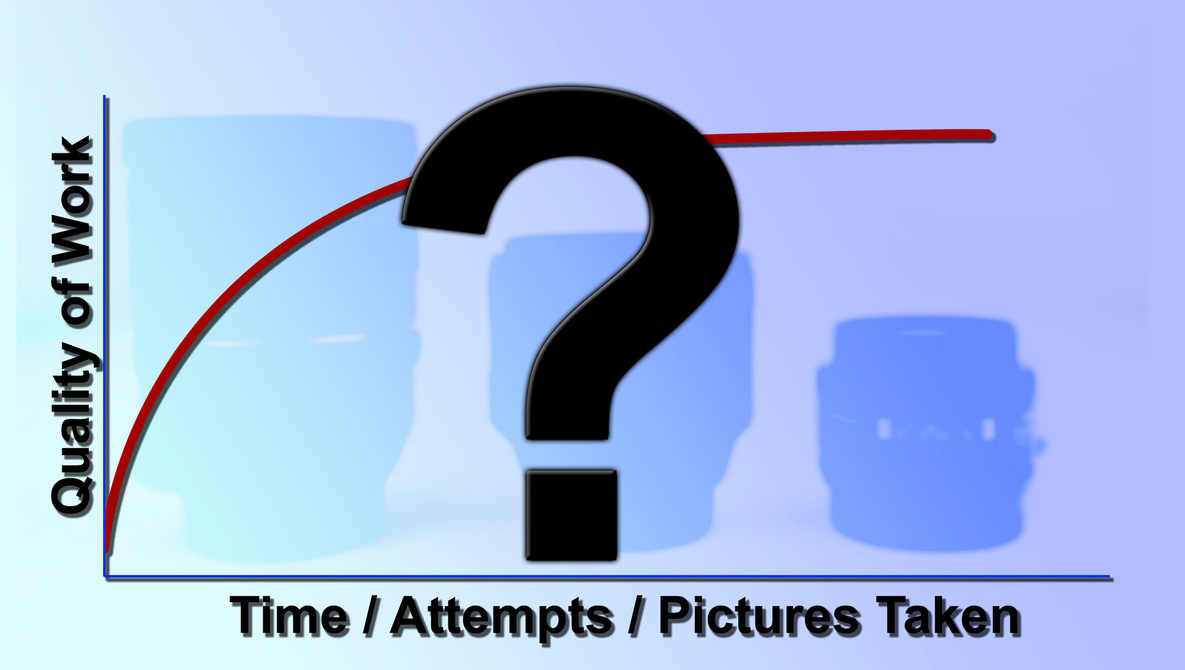
Even though we repeat it quite often, photography doesn’t have a steep learning curve. Actually, the curve looks different for every photographer. Still, it can teach us something.
What Is a Steep Learning Curve?
Far too often, we (myself included) talk about a steep learning curve in photography. Most of the time we assume that it takes a lot of time and effort to master photography. The “steep” path lies in front of us. We make our way through the hills of exposure, climb the peak of light, and enjoy the breath-taking vista of the mountain range of composition. But are we really talking about a steep learning curve, here?
Actually, we’re not. We’re talking about a hard process which is far from being visualized as a steep curve. Why? Because in maths, a steep learning curve would be a process in which we quickly achieve substantial progress.
A Theory of Learning Curves
A learning curve is a graph which describes how productive we are in relation to the time we spent working on something. In our case, that “something” is photography. The system of coordinates consists of an x-axis, which describes the time spent with photography related activities. On the y-axis we enter the quality of our photographs.

If photography was a steep learning curve in the mathematical meaning, we’d witness a very quick process. As soon as we start, our success would rapidly increase with each and every image we take. In the graph below, this is the very left part of our learning curve. Steep doesn’t mean “hard” here. It means fast. Just after a while, the marginal improvement of the quality of our work decreases. We make minimal effort with every new image. But we never completely stop learning. This is where the graph results in an almost horizontal line.

Unfortunately, photography doesn’t work like this for anyone I know. Even though many things get easier and easier due to modern technology and the accessibility of a broad variety of high quality books, online courses, and videos, we don’t reach the master’s level quickly. Most of us never do. So, what does our learning curve really look like?
Quality of Photography: A Complex Determinant
Everyone’s learning curve looks different. In fact, we will have trouble in comparing our learning curves, because our success will be subjective. While we can easily define our x-axis in hours or pictures taken, we can’t really objectively measure the quality of our work. To create a quantitatively measurable scale, we need to translate the quality into numbers. We could use the amount of likes on social media, but that’s not really a variable to define quality. It’s also depended on third factors like marketing and hashtags.

We could also quantify the quality of our images by rating them with a certain score. We simply rate our images from 1 to 100 and will probably see that we gain higher scores the longer we practiced. But what about lucky snapshots and “bad” subjects? Shooting a model will usually result in better images than amateurs. We’d have to consider the complexity of the task as well.
Additionally, we can assume that we can only rate our images retrospectively. Beginning photographers will read images differently from most professionals or advanced hobbyists. If I take a look at the images, which I found outstanding a few years back, I will find some nice images, but also some horrible failures from my today’s point of view. And we haven’t talked about other’s opinions, yet.
Check Your Own Photography Learning Curve
Overall, we can’t objectively measure the quality of our images. We can only describe what we feel and felt. After reflecting on our learning process, do we find that we’re making swift progress or that we’re treading water? How long did we have the feeling that we didn’t learn anything and when was our last time of yelling “Eureka!”? This is our feeling. We can also add a more critical curve that takes a look at the quality of our images from our todays point of view.
Looking back at how successful I felt in the past and how I judge my older images today, I would draw the following graph:
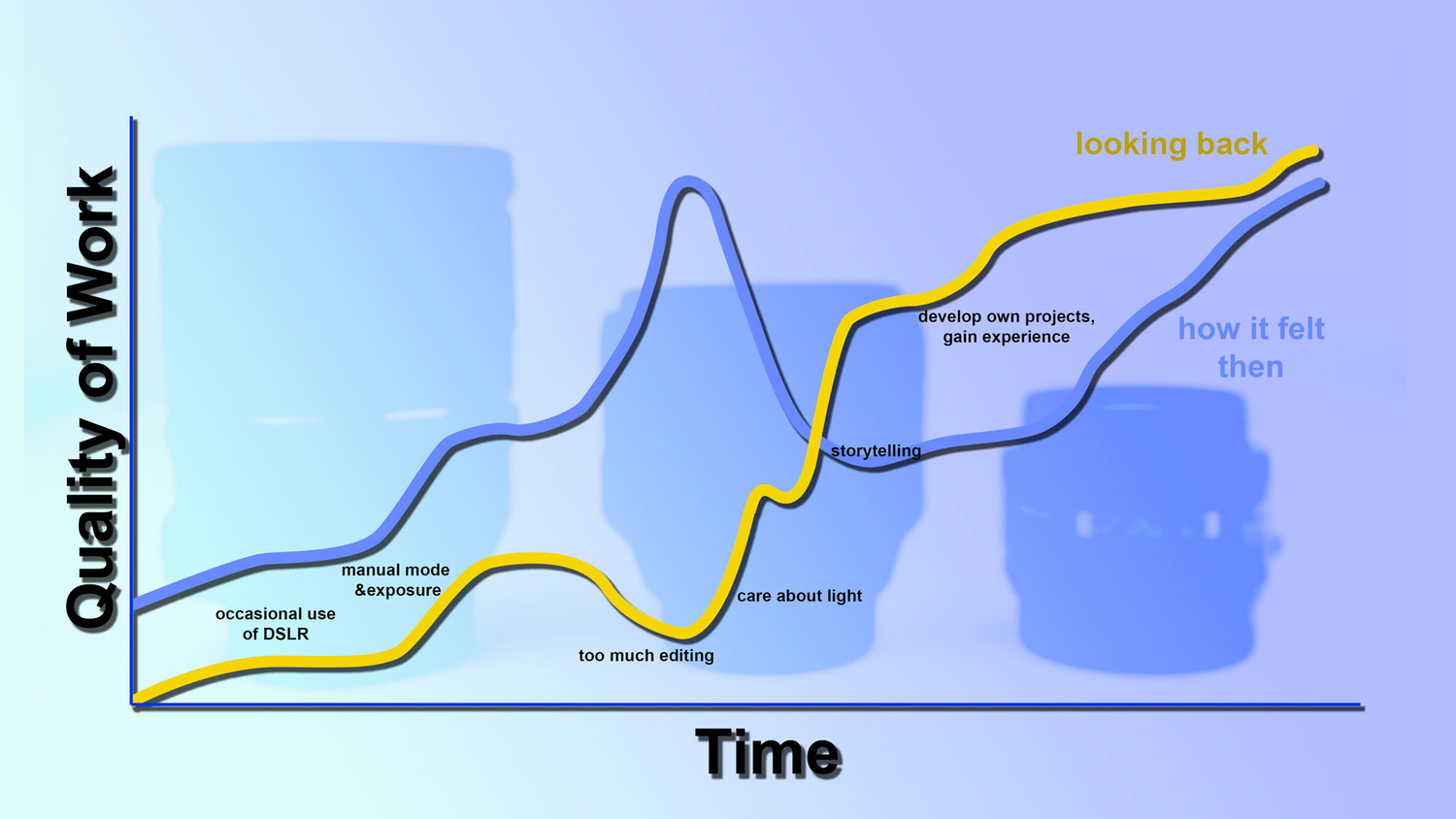
In the beginning, I owned a DSLR and did only use it for fun and to document my travels and events with friends. After a while I wanted more and started reading about exposure and what’s going on inside my camera. I felt quite advanced already, even though my pictures were hardly distinguishable from snapshots. Then, I went into the magic world of post processing.
Initially, exploring the world of Lightroom and Photoshop was far from being an improvement, but it felt like I suddenly knew everything. I am a little ashamed about the images whenever I open my old folders. Yet, I feel happy that all these new discoveries kept me busy and engaged.
After a while, my progress became quite the opposite. After I built up my first DIY-studio in my student’s dorm, tamed my affinity for heavy edits, and started to shoot headshots for friends, it felt like stagnation. I was excited to learn more and more, but soon realized that new gear didn’t boost my skills, because… well it’s just gear.
I joined different photography groups online and shot more and more pictures. A feeling inside of me told me to go on, print images and discuss them, even though it felt like no progress at all. Because I learned how to read photographs, I scaled up my ambitions and standards, which I couldn’t meet too quickly. Feelings can mislead us, sometimes. Today, I think that I made great progress during this period of self-doubt and tentativeness.
Luckily, I didn’t give up but searched for inspiration. In the need of staying an active photographer, I went out to do some travel photography and use my camera as a tool to find new adventures. I didn’t care about improvement anymore but started to become curious again. I researched my subjects before I shot images of them and got more into storytelling. After a while, I managed to get my first jobs, shoot for different clients and develop my own projects. And this is where I am: I still look at my images in a very critical manner, but I guess my own feelings are closer to meeting reality than before. And still, there are infinite lessons to learn.
The Lesson of the Learning Curve
Why do we talk about a learning curve, if it’s not measurable, highly subjective, and not generalizable? Because we want to exchange how hard photography is and not only because it’s hard to learn. Mostly, because the speed of our process varies. Taking a look at my learning curve, you will find periods where I learned a lot in a short period of time (a mathematically steep part of the curve) but also struggled and hardly learned anything at all (colloquial steep). There even was a time where the quality of my images decreased, even though I thought they were outstanding. Remarkably, my Instagram likes reflect the feeling curve quite well, even though I really created them independently.

Whenever you’re stuck or only think that you’re stuck, you should visualize your own learning curve. It might be steep, it might be moderate, or even flat. There are times when you misjudge your own efforts. Sometimes, you’re really treading water. In the long run, however, there is one commonality in all our individual learning curves: They’re all ascending.