

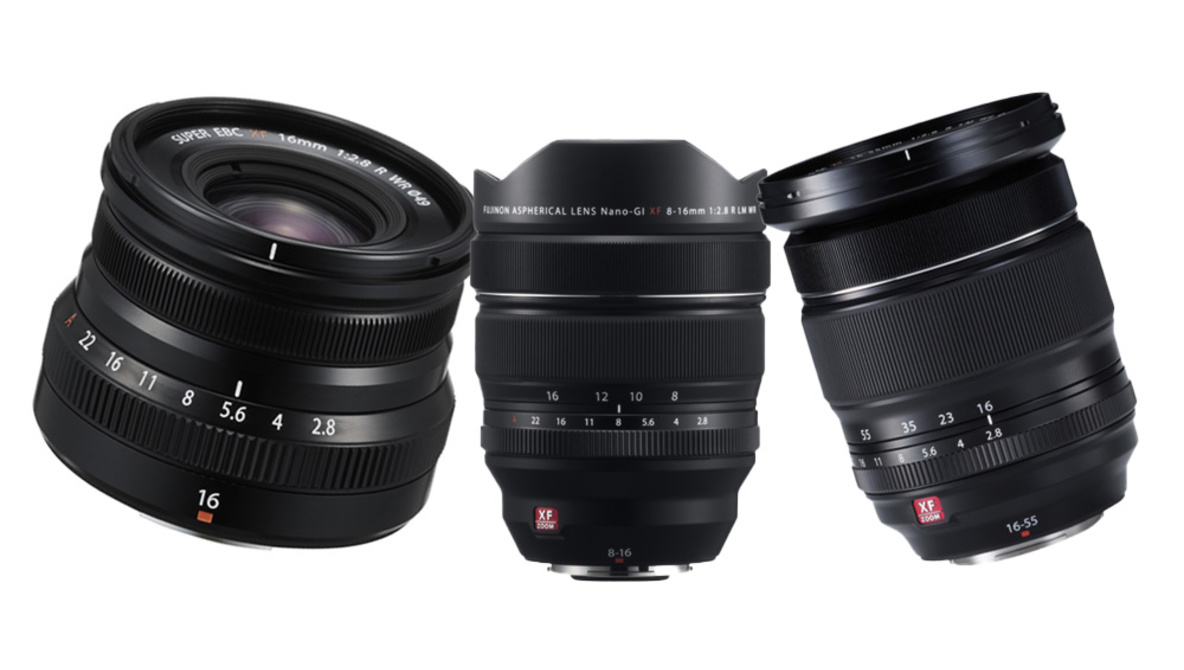
So, you shoot Fujifilm and need to achieve 16mm f/2.8 and you’re not sure how to get there? Let this be your guide.
Fujifilm makes four lenses that can shoot at 16mm f/2.8. The 16mm f/1.4, the 16-55 f/2.8, the 8-16mm f/2.8, and the new 16mm f/2.8. I am not including the f/1.4, because when shooting at f/2.8, it has an unfair advantage in this test — we want to keep all three with f/2.8 as a constant variable. Let’s go through these lenses one by one.
16mm f/2.8
Out of the three, this lens is probably my favorite technically. It’s sharp, with minimal distortion and vignetting, and small. It’s odd how close in size it is to my 23mm f/2.0 while being such a different focal length, but I guess Fuji wants this the 23mm and the 35mm f/2.0 to feel like the same family, as all three are very similar in size and weight with only 25 grams separating the lightest (the 16mm f/2.8 at 155 grams) and the heaviest (the 23mm at 180 grams).
But that’s neither here nor there. The question is how the lens performs. The 16mm f/f/2.8 lens is a part of what I call Fuji’s “Gen 2” lenses, which is anything after the 16-55mm f/2.8, where Fuji updated their autofocus mechanisms, improving AF performance, and this lens shows this off in spades with some snappy, fast autofocus!
As you can see in the sharpness test above, vignetting is there, but under control, and distortion is very minimal, especially when compared to the 16-55mm f/2.8.
16-55mm f/2.8
The 16-55mm f/2.8 is the only lens of the three I actually own. It is a grand lens, a versatile shooter with a 24-82.5mm focal range in full-frame talk. This lens may not be the sharpest, though it is sharp, and definitely has more distortion than the other two lenses at 16mm, but it is probably the best catch-all lens. But we are (trying) to not talk about the other uses of the lens and just talk about the 16mm end, and in this case, I would say it is the weakest of the three with the most distortion and the most vignetting at 16mm.
8-16mm f/2.8
On a technical level, this lens is right in the middle when it comes to 16mm lenses. It has less distortion than the 16-55mm and is slightly softer than the 16mm f/2.8. This lens is definitely a specialty lens and priced that way. The 8-16mm gives it a 12-24mm equivalence. But I want to concentrate on just the 16mm end of the spectrum! If you want an in-depth review of this lens, fellow writer Dylan Goldby wrote a fantastic review here, and while this lens is pretty freaking great, I feel it is too expensive and too much of a specialty case to recommend as the best 16mm f/2.8 out there.
Which Should You Buy?
Well, it all comes down to use. Are you a portrait/fashion/event photographer? The 16-55mm f/2.8 is your best bet. While it is not the sharpest (that goes to the 16mm f/2.8 prime), it is definitely the most versatile.
Do you shoot a lot of architecture, or aspire to be the next Mike Kelley? The 8-16mm is going to be your best friend in the world, able to get the widest of wides while also being versatile enough to capture those all important medium wides.
Are you a street shooter? Looking for something a little wider than the 23mm f/2? The 16mm f/2.8 is your best bet. If you have the money, the 16mm f/1.4 is faster, but if you aren’t shooting a lot of low light, you may be better off with the newer 16mm, as it is smaller, cheaper, and lighter. This is definitely the sharpest of the three, though I personally find sharpness overrated unless you’re printing big.
Do you have any of these three lenses? Which did you choose and why?