

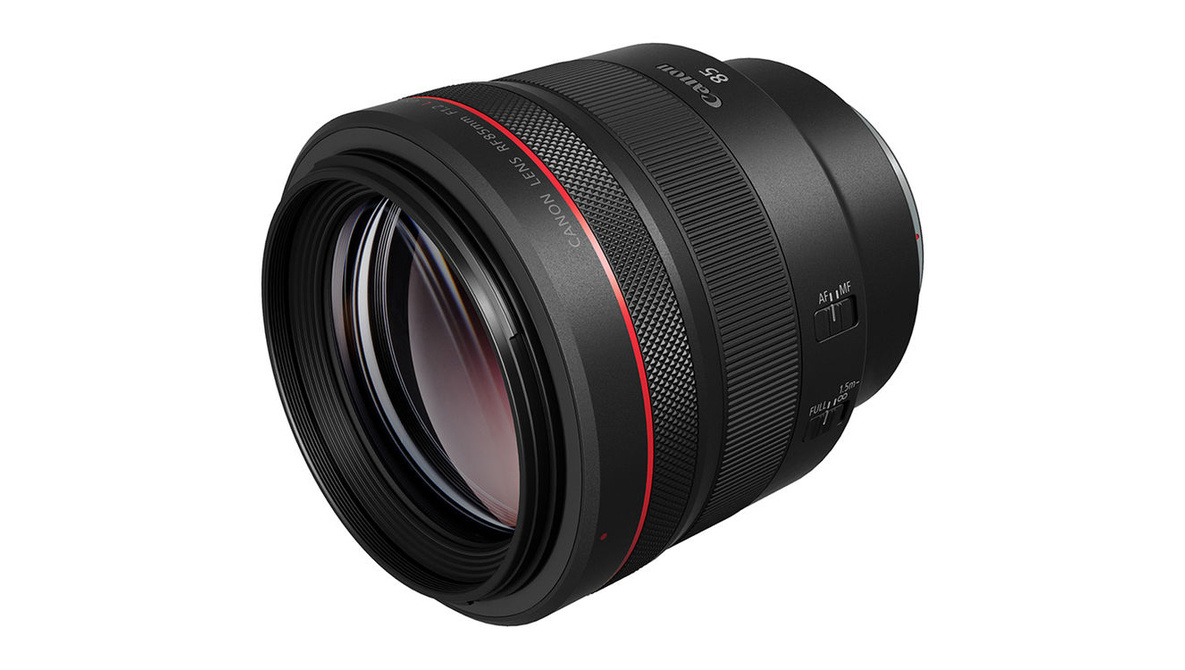
Canon’s new RF 85mm f/1.2 L has been officially announced, along with a hefty price tag. Considering the specifications and market this lens will compete in, is the price fair?
First, a little about the lens: it’s the latest twist on Canon’s storied 85mm portrait lens, refined for the RF mount and featuring the first RF-mount implementation of Canon’s BR optics, which are designed to reduce chromatic aberration. The lens has a very fast aperture, along with a correspondingly heavy weight. It actually picked up another 1/3 of a pound over the EF mount 85mm f/1.2.
Overall, this lens fits squarely into Canon’s RF mount lens strategy, which could be summed up as wider apertures and higher performance at any cost. Along with the 28-70mm f/2, this lens is meaningfully heavier than the EF version it replaces, but promises to the highest levels of optical performance.
Based on all the specifications, it’s clear that Canon sees this lens as a continuation of the legacy 85mm f/1.2 lenses from the EF mount. So, comparing it to its predecessors reveals some interesting similarities. First is the price, since at $2,700, the RF version is very expensive for a prime lens under 200mm. This isn’t without precedent, however, as the original EF 85mm cost $1,500 at release, which when adjusted for inflation, would be over $3,000 today. Next is Canon’s expected user of the lens, with Canon again identifying portrait photographers as the key buyer.
Where things get interesting is when you consider price and expected use case against other options in the market. Back in 1989, when the first version was introduced, it was very unique. Now, however, there are many more fast prime options, both from Canon and 3rd party manufacturers. Canon’s EF 85mm f/1.4 features image stabilization, 1/2 pound less of weight, and a price that is $1,200 lower. While the RF lens will probably be sharper, and is claimed to have less chromatic aberration, the EF f/1.4 seems to be a much better match for the existing RF bodies size and budget. Sigma’s well regarded 85mm and 105mm Art lenses can both be bought for less than Canon’s RF 85mm.
While these alternate options aren’t the latest in lens design, they are substantially cheaper. While they don’t reach f/1.2, that aperture can sometimes be more bragging rights than useful, considering the razor thin depth of field it comes with. Gear choices always bring compromises. Fortunately, the compromises inherent to the RF 85 are clear: heavier, larger, or more expensive than other fast short-telephoto primes, but with excellent IQ and the fastest aperture available.
One last consideration is that this isn’t Canon’s only 85mm prime for the RF mount. A version with defocus smoothing, to produce “beautifully smooth defocused bokeh”, is also announced, but still lacking many details. I’d expect this to be even more expensive, but if you’re in the target market, it may be even better suited to your purposes.
Canon’s RF mount strategy has been a point of personal contention for me. I’ve felt that the lenses are following a much clearer strategy than the bodies, where Canon’s optical engineers are free to create the highest performance optics, without restriction. Looking at the lenses announced, clearly no concession has been made for weight or cost. While neither weight nor cost are out of line with the precedent lenses, Canon’s RF lens offerings could be described as 10% better for 50% more cost. For many photographers, I don’t expect this tradeoff will be desirable, but for a smaller portion, they are offering lenses you can’t get anywhere else. To answer the title question: yes, $2,700 is fair, considering the relatively unique niche this lens occupies. Even if you are in that niche, however, it may be worth considering some of the alternate options that have come out since Canon first introduced the 85mm f/1.2.