

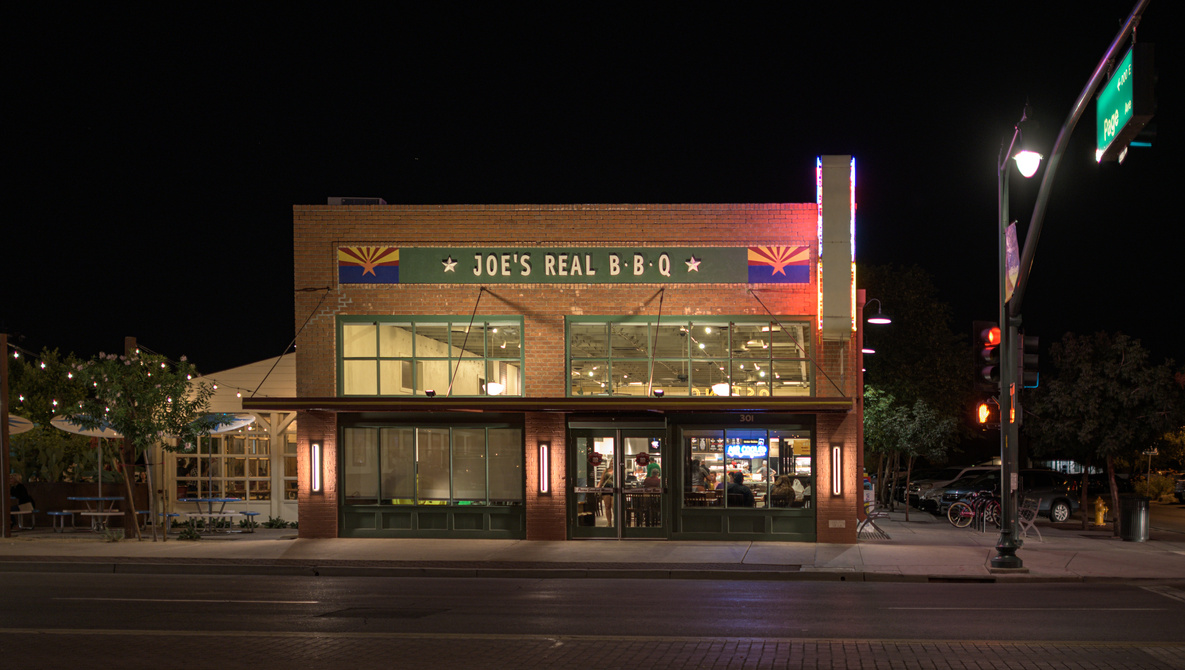
The announcement of Night Mode promises “low-light shots never before possible on iPhone.” Between the new mode and the addition of a truly wide lens, the iPhone is more competitive than ever. But do the shots actually hold up in the field? I tested against my Nikon Z 7, with surprising results.
Before the comment section sharpens their pitchforks, let me clarify that this isn’t a scientific test. While I tried to keep things comparable and rigorous, this test was undertaken entirely to build my understanding of the capabilities of my new phone and hopefully provide some insight into the capabilities of the new iPhones for everyone.
Two Roads Diverged
What makes this an interesting comparison, at least to me, is the two very different paths taken to create these shots. Apple is using a tiny sensor, which, even paired with a 26mm f/1.8 lens, shouldn’t be able to compete with the comparatively huge full frame sensor in the Z 7. To make up for the hardware deficits, Apple relies very heavily on software processing. Apple leverages the significant processing power of the A13 along with techniques like stacking to produce a result. Meanwhile, Nikon provides the raw file from a large sensor and fast lens, with users expected to change shooting and post-processing techniques to create their desired output.
Computational photography-focused hardware has been explored in a number of ways over the last few years, including Lytro and Light’s L16. Computational post-processing techniques have gained wider use in implementations like focus stacking and noise-reduction stacking, but hardware implementations in major cameras are still lacking. As a result, I think this test can be treated as a tiny preview of the two directions cameras are evolving towards.
The Test
The major thing I wanted to test was the iPhone’s ability to be used as a replacement for a walkaround camera, particularly in lower light. To keep this use case in mind, I kept the setup on the Z 7 minimal, with no tripod, but using a higher ISO and VR. On the Z7 was a 24mm f/1.4 and FTZ adapter. The iPhone was entirely stock, including the use of the default camera app. Both shots have minimal post-processing, which does lend an advantage to the iPhone, but again, goes along with the emphasis on ease of use.
With all the disclaimers out of the way, let’s take a look at a shot. Can you guess which comes from the iPhone and which comes from a full frame mirrorless camera with 24mm f/1.4 lens?


The shot on the bottom comes from the Z7. Both at full resolution and resized to match the lower resolution iPhone shot, I prefer the iPhone’s output (top shot). While the fine detail isn’t there, the straight-out-of-camera look is definitely cleaner. Partly, this is because of the iPhone’s much more aggressive noise reduction, and partly because the iPhone struck a better white balance. The iPhone shot also has much higher contrast, with no easy way of tweaking that.
In this second set of shots, you can see how the very things that made the iPhone shot look better are now cutting against it. With a mixed lighting source, the iPhone’s higher contrast and saturation make this shot look overprocessed, particularly in comparison with the Z 7 shot. Again, the Z 7 isn’t significantly processed, so the color and contrast can definitely be refined beyond this more flat look. When tweaking the Z 7 shot in Lightroom, the lights have much more headroom for recovery, while the shadow areas have retained much more clarity.
This third set of shots is the perfect summary of the two different looks these cameras create. The iPhone shot has the characteristic one-dimensional rendering of a cellphone shot, with generous depth of field, higher contrast, and a preference to expose for the shadows. The Z 7 shot is much darker, as the meter was trying to save the highlights in the exposed light fixtures, but with a quick bump in exposure, opens up easily.
For this last one, I wanted to include a comparison of a tweaked Z 7 shot and the iPhone shot. The Z 7 shot was quickly brought up in LR to roughly match the iPhone’s contrast, vibrance, and overall exposure.
My Thoughts
Even now, a few days after getting the iPhone, I’m impressed by the capabilities. Night Mode is a massive leap beyond past iPhone’s low-light ability and clearly worthy of praise. In comparison to the full frame camera, particularly at smaller sizes, it can trade blows with SOOC shots.
Where it falls short isn’t going to surprise most photographers: the lack of control inherent to a phone camera means shots can be hit or miss. The Z 7’s files have far greater latitude for processing, with the iPhone’s shots being relatively “brittle.” Additionally, the Z 7 provides far greater flexibility in choice of shutter speed and control of DoF.
The Night Mode option isn’t great for subjects with more movement, as you’ll need to be still for at least 3-10 seconds to allow the iPhone enough time to build its image. An additional issue I noticed was the large amount of lens flare, despite the lens being factory clean. Given enough time and scratches, this could become a problem.
These aren’t deal-breakers, however, as the easy portability means the iPhone is a great choice for a pocket camera. The inclusion of a truly wide angle lens leaves most point and shoots in the dust, in my opinion.
To answer the title question: yes, the iPhone can match a full frame camera at night, but with some big asterisks on that answer. Handicapping the Z 7 in terms of post-processing is a huge benefit for the heavily processed iPhone shots, while resizing further tilts the field in favor of the iPhone. While I won’t be replacing my camera with my phone anytime soon, I’m very happy to have another tool in my bag, particularly to fill the niche of an unobtrusive, pocketable camera.
More broadly, these results should leave photographers excited about the possibilities of computational photography. While makers have just dipped their toes in the water, with support for sensor shifting and focus stacking, I believe the field has great potential. We’re already seeing new lens designs that make greater use of digital corrections for analog compromises, like distortion and vignetting. The processing power and software know-how that power the iPhone could do amazing things with a higher caliber sensor and lens.