

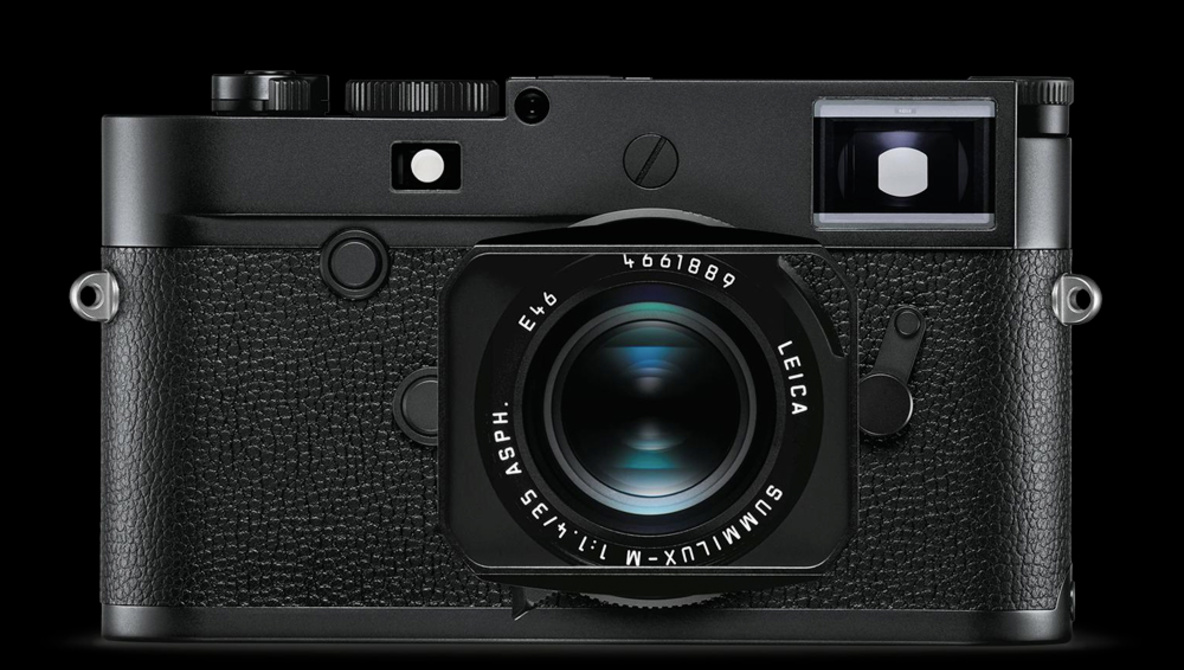
With Leica having just released the beautiful but insanely expensive M10 Monochrom, there’s a good question why other camera manufacturers don’t do the same. Would you buy an Sony a7M III, a Fuji X-M3, or even a Canon EOS Rm?
A quick summary of what Leica has done with the M10 Monochrom: The Monochrom series of cameras are built without a color array filter sitting on top of the sensor. Camera sensors can only detect luminance and cannot detect wavelength, so this Bayer color filter mosaic is placed over the pixel sensors to allow it to detect the intensity of red, green and blue light.
The result is that less light is hitting the pixel sensors, and by removing this mosaic, the sensor can no longer differentiate colors, but is more sensitive and able to offer greater detail, as well as creating something similar to film grain rather than noise when pixel-peeping. As B&H Photo’s Allan Weitz eulogizes in this video, the gradation of tones in the resulting images is far superior (your mileage may vary), though it would take a true aficionado to appreciate the difference. For most photographers, processing a raw file in black and white is probably enough, but for the hardcore, what Leica offers is something that can genuinely be appreciated.
(By the way, to those that think that $8,300 is not that expensive for a camera that shoots only monochrome images, be sure to check out the Phase One XF camera coupled with an IQ3 digital back. 100 megapixels of black and white, medium format goodness. Enjoy.)
If you’re wondering if you can simply crack open your own digital camera and pull off your Bayer filter, I’m delighted to tell you that it’s possible, but according to the intimidatingly knowledgeable Joseph Wisniekski, it’s not exactly a simple process. It sounds like there’s a good chance that you might expose yourself to some pretty nasty chemicals, and the exact procedure will differ between manufacturers, if not between individual cameras of the same make, so there will be a fair amount of trial and error. If you fancy converting your 5D Mark IV, it’s probably useful to have more than a handful of them available so that you can refine the process.
As Wisniekski explains in this forum post over on DPReview, you simply need to “dissolve the color filters and the microlens array from the sensor using other dangerous solvents and possibly more heat. There’s nothing more fun than hot solvents: the heat multiplies strength as irritants, carcinogens, and explosives.”
If you’re wondering if you can pay a company to do this for you, it’s possible, but you’ll need to hope that the camera you want to convert is one that the company is set up to convert. A simpler option might be to buy an already-converted camera, such as those for sale through MaxMax, a small business in New Jersey that has a long history of converting cameras. However, expect there to be a bit of a bump in price to the second-hand, modified camera that you’re about to buy. This is a niche process requiring ridiculously specialist knowledge and, understandably, it doesn’t come cheap. A Sony a6000 that would cost you a little over $400 from that secon-hand camera store will set you back $2,000 once it’s been completely disassembled and that pesky coverglass, micro lenses, and color filter array have been pried from the surface of the sensor. (I should add: given the amount of work, equipment, chemicals, and expertise that go into this process, that’s a bargain.)
Late last year, Canon announced the EOS Ra, a camera designed specifically for astrophotography. Essentially, Canon took the EOS R and incorporated an infrared-cutting filter that allows the sensor to receive up to four times more hydrogen-alpha rays at the 656nm wavelength. This means that distant nebulae and other subjects can be captured without any “unwanted infrared contamination.” Basically, it sees night skies really well.
Right now, you can grab a regular EOS R for $1,800, while the astro version is $700 more expensive at $2,500, though that’s only a few hundred dollars more than the regular R’s price at launch. Given that Canon was essentially adding a component (the IR cut filter) to the EOS R to make the Ra, with a monochrome version, they’d instead be omitting a component (the Bayer filter), so at a glance, logic suggests that it shouldn’t add dramatically to the price. Of course, it’s probably not quite that simple, even before economies of scale are taken into account. For example, someone a lot smarter than me will tell us in the comments the implications for the dual pixel autofocus.
Autofocus aside, would a monochrome version of the EOS R have as broad appeal as an astrophotography version? Possibly not. The beauty of the Leica M10 Monochrom is that it is a compact rangefinder that lends itself well to street photography (and people who love to focus manually). If it were just a case of size, perhaps a monochrome version of the EOS RP might be a little more realistic, and it could offer a suitably compact unit when coupled with an RF pancake, if and when such a lens emerges.
A more obvious (affordable) monochrome camera would be something from Fuji, and there have been rumblings about this in the past. With the compact bodies and slightly more hipster leanings, I’d certainly be tempted by an X30m, an X100Fm, or an X-Pro3m. If I’ve just tempted you, please note that you can snag yourself a monochrome X100T from MaxMax for $2,600.
The guys at Fuji Rumors have been campaigning long and hard for Fuji to release a monochrome version, and if you fancy offering them your support, you can add your vote to this poll. You’d imagine that if Fuji is bold enough to produce a digital camera with a concealed rear LCD (i.e., the XPro3), a camera that only shoots in black and white doesn’t seem all that niche, surely?
What do you think? Which camera would you convert? And should Fuji take the risk and bring an affordable monochrome camera to market? Be sure to leave your thoughts in the comments below.
Lead image courtesy of Leica-Camera.com.