

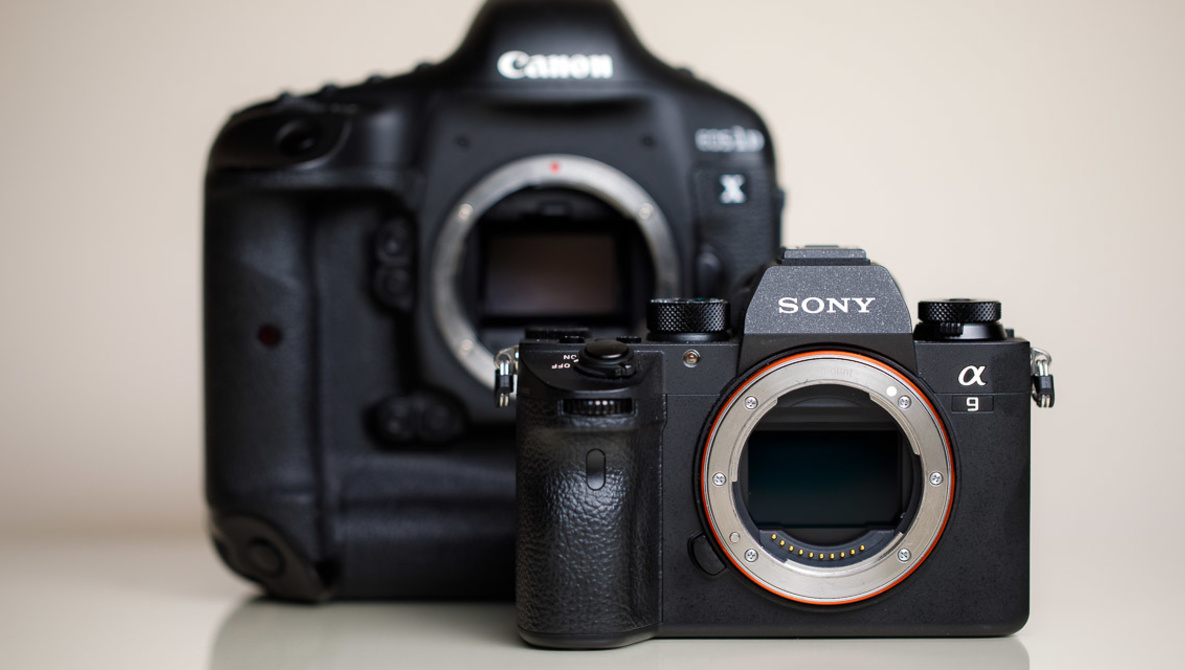
The DSLR has been called a dinosaur on the brink of extinction. It has been called old-fashioned, or even outdated technology. It is all because of the mirrorless cameras that hit the market a few years ago now. Let’s have a look at the differences between the two and find out if both systems can live next to each other.
Technology is making huge leaps. It is all because of the chips that are getting smaller, faster, and more energy efficient. It is making things possible that would have sounded as science fiction in the old original Star Trek series. Technology has made our cameras advanced computers capable of amazing things.
We got a screen on the back of our camera to view the photo we took a second before. It is possible to judge the result and change settings if needed to acquire a perfect photo. Although the consumer compact cameras already used these screens as a sort of viewfinder, the traditional DSLR camera kept using a mirror and pentaprism to see the image as projected by the lens. It was no surprise to eventually see a small screen appear inside the viewfinder, making the mirror and pentaprism no longer necessary. The modern mirrorless camera was born.
We are at a moment where the mirrorless system has reached maturity, I think. Electronic view finders are almost as good as the real thing, and will probably getting even better in the next years. Cameras can be smaller and lighter because there is no longer a mirror and pentaprism inside. It does not make the photography equipment smaller, though, because the sensor sizes still require the same large lenses.
Now we have reached the point where there are two different types of camera. We have the traditional digital single lens reflex camera, the DSLR, and the new interchangeable lens mirrorless cameras. Both have the possibility to change lenses, use flash guns, and share all the same benefits. The only difference is having a mirror and pentaprism, or not.
Or is it? Lets have a look to a few differences.
1. A Mirrorless Camera Can Be Much Smaller Than a DSLR
Although it does not applies to all mirrorless cameras, it is possible to make a mirrorless camera very small. The mirror and pentaprism take up a lot of space. Removing it allows the body to be much smaller, and lighter. The absence of a mirror make it also possible to place the lens closer to the sensor.
Although the camera body does not need the traditional DSLR look, many mirrorless cameras resemble the design of a DSLR. While some manufacturers miniaturize the mirrorless, making it as small as possible, some keep the size relatively large, resembling the full size DSLR. I find the extremely small camera bodies not that comfortable, but opinions differ.
2. A Mirrorless Camera Is Not Necessarily Less Complex
Even with the absence of a complex mirror, a mirrorless camera is not necessary less complex. The complexity is just very different. Indeed, a mirrorless has fewer moving components, which probably is much easier to build. But the complexity is more software related. The sensor is used constantly and not only has to register the light when a photo is taken, it also is used for focusing and measuring exposure.
Also the electronic viewfinder needs to have very high refresh rates to imitate a optical viewfinder as much as possible. And the image on the screen needs to amplify enough for it to be able to see in dark environments.
3. A Dedicated Autofocus Sensor inside the DSLR
Every DSLR has a dedicated autofocus sensor hidden underneath the mirror. This dedicated sensor makes it possible to optimize it for just one purpose. The autofocus can be made very fast, responsive, and flexible. It is perfect for fast action and tracking objects and DSLR still outperform the mirrorless autofocus systems at this time.
Nevertheless, the mirrorless autofocus systems have other benefits. It is much easier to use the complete sensor for measuring focus distance. It also is possible to recognize faces or even eyes. For this, some mirrorless camera performances are amazing and perhaps better than the DSLR systems. I am sure the next few years mirrorless technologies will advance to match action and tracking objects like a DSLR.
4. Electronic Viewfinder Shortcomings
The absence of a mirror and pentaprism makes it necessary to use a digital screen for a viewfinder. The pixel density of these small screens have to be very high to have a good resolution. These screens are becoming better by the year and almost resemble the details you can have with an optical viewfinder.
Refresh rate can be a problem of electronic viewfinders. Especially with fast moving objects, and tracking objects, the refresh rate may be not enough to imitate a real optical system. Also modern LED lights may flicker a lot when these are working with almost the same frequency.
I have found the electronic viewfinders being less usable with night photography. Looking through the viewfinder make you lose your night sight in dark environments because the screens always emit light. Depending on the camera it may also be difficult to generate a usable viewing image on the screen.
5. A Mirrorless Camera Always Has To Be Activated
When using a DSLR you can always look through the camera to see the things you want to photograph. You may just want to look for a composition, or use it in another way. For this, you don’t have to switch on the camera.
With a mirrorless camera you always need to switch on the camera, even if you just want to take a look at a possible composition. Over the years I personally have found this to be one of bigger disadvantages, although you will get used to it. If I had a choice, I rather have an optical viewfinder.
Which is Better?
These are just five obvious differences between a DSLR and a mirrorless camera. But regardless of the differences, both types of cameras are very capable machines, each having their own strengths and weaknesses. I believe it is foolish to bash one system over the other because in the right hands both systems produce the same qualitative photo. In other words, both have a right of existence, and can live next to each other without a problem.
I have photographed extensively with both DSLR and mirrorless cameras. I used Sony, Nikon, Canon, Panasonic, Fujifilm, Leica, and Hasselblad. I have seen the differences, similarities, and experienced how both DSLR and mirrorless cameras perform in real life situations. Based on my experience I can advise everyone to use the system you like the most without worrying about the other camera system. Never forget, the camera is just the tool. Nothing else.
What kind of camera system do you use? It is mirrorless or DSLR, and it there a reason why you are using that camera system at this moment? Please leave your answer in the comments below.