

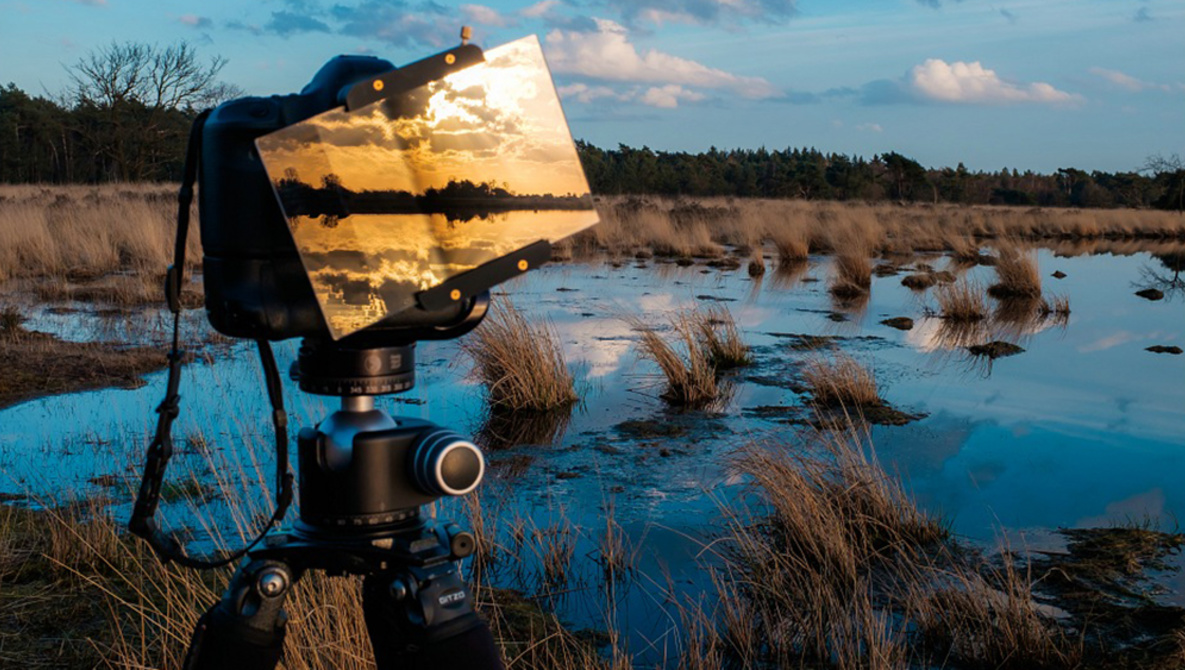
The use of filters is very popular among landscape photographers. There are a lot of beautiful filters available that can help capture the landscape in the way you want to. But how useful are these filters in reality? Let’s have a look.
One of the difficult things in landscape photography is capturing the scenery the way you experience it. Often the dynamic range is larger than what the camera sensor can register, especially when we shoot sunsets and landscapes with part sky, part foreground. Although the dynamic range of modern cameras has increased, often you will have the risk of clipping highlights or shadows.
There are ways to avoid these problems, like shooting exposure bracketing. And it is possible to use neutral density gradient filters to reduce brightness in parts of the image. These filters allow you to reduce two, three, or four stops of light. By stacking filters it is even possible to increase this significantly.
There are roughly three types of neutral density gradient filters; the soft gradient, hard gradient, and the reverse gradient. These filters should allow you to reduce the dynamic range of the scenery in such a way, that it will fit within the limits of the camera sensor.
But this all is theory. When using filters in reality, some problems may occur. I have gathered seven reasons or situations, where these neutral density gradient filters may not be the only, or perfect solution.
1. You Have to Carry Extra Things
I want to start with something that I don’t find a big of a deal, but it might become a problem on some occasions. Most neutral density gradient filters are big and often vulnerable. Sizes like 100x150mm are standard, but there are also bigger ones. A smaller size is also possible, often for the micro 4/3 system cameras, or similar small size cameras. But even then, the relative size is enough to take a lot of space in your camera bag.
I use a very handy Mindshift Filter Hive, that packs in about the volume as a 70-200mm f/2,8 lens. If you love to take a lot of lenses with you, or you prefer to have a small camera bag, it might become difficult to find any place for all those filters.
2. Risks of Color Cast and Reduced Sharpness
Most lenses are designed to produce razor sharp images with a minimum amount of color cast. We pay a lot of money for those lenses, and don’t accept any less. By placing a filter in front of that expensive lens, it may reduce the quality of the image.
In most situations you won’t notice any difference in sharpness. But when using high resolution cameras, it may become noticeable. The amount of degradation also depends on the quality of the filter and the material it is made of, of course.
Color cast is another big issue, especially when the neutral density part is really dark. Although color cast can be corrected in post-processing, it will occur not equally over the image when using neutral density gradient filters. After all, it has a gradient. Also the amount of color cast depends on the quality of the filter, and the material the filter is made of.
3. Increased Risk of Reflections and Flares
Just like a degradation in quality, the filter may increase a risk of reflections or flares. Most modern lenses have a certain resistance to flares. By adding another piece of glass in front of the lens, it may counteract that resistance. Having direct sunlight in the image, some filters may even increase the amount of flares in such a way, the image will become unusable.
In the worst case situation the filter will become a mirror, reflecting the front of the lens. This is not always a big problem, but when there are notations on the front lens, these will become visible and sometimes even readable. A good quality filter may reduce the risk, though. Stacking filters will increase the risk.
4. Filters Are Expensive
As I said, good quality filter may decrease the risks of color casts, reduced sharpness, and flares. But these filters are often very expensive. Buying a high quality starting set may cost you up to $1,000, or even more.
Spending such an amount of money is not always necessary. You have to take the resolution of your camera in mind, just as the quality of your lenses. It is no use buying very expensive filters when the lenses you use aren’t producing the best image quality. Also, very expensive filters are absolutely no guarantee for images without flares or other lens defects.
On the other hand, buying cheap filters of a lesser quality may become problematic when you upgrade your lenses, forcing you to buy another set that has better quality. Sometimes it is better to buy a good set the first time. Whatever you do, filters will always be expensive.
5. Struggling With an Uneven Horizon
Up to now I have mentioned filters in general, not the practical use in the field. The fifth downside is a more common problem regarding neutral density gradient filters; they always have a straight gradient.
When a straight horizon is present, a neutral density gradient filter can be used without problem. If something is obscuring the horizon, like trees, houses, or even mountains, a straight gradient may not be the best way to reduce the brightness of the sky. A filter won’t take the objects that break through the gradient into account. As a result the top of the mountains will also become darker.
6. Imbalance in Brightness Between the Sky and Any Reflections in the Foreground
I find the biggest problem of neutral density gradient filters is the imbalance in brightness that can occur when something like water in the foreground is reflecting the sky. By darkening the sky with a neutral density gradient filter, the water will still reflect the light sky. This imbalance makes the image very artificial and it may require you to perform a lot of post-processing to correct this.
7. I Can Use a Gradient Filter in My Post-Processing Software With More Flexibility
The modern post-processing software often allows you to add a digital gradient filter to any image. It will imitate the use of a real filter, without all the problems as I mentioned previously. You might even use a mask, to mask out any objects that break through a straight horizon, or to reduce brightness of parts in the foreground that reflect the sky.
The digital way of adding a neutral density gradient is more precise.
Why I Still Use Filters Regardless of All These Downsides
When I shoot landscapes, I almost always use neutral density gradient filters when a part of the image is much brighter than the rest. This might sound strange, when reading all the downsides of real filters. But for me photography is about registering the landscape on location, and capturing it in a way that is as close as possible to how I experience it. I love photography, and playing with filters to accomplish this, rather than trying to acquire this when sitting in front of a computer.
Nevertheless, when using filters I often also use exposure bracketing. I find the reduced dynamic range when working with these filters a benefit. It makes it much easier merging images into the final result.
Final Word
Although there might be more effective ways of registering a landscape, I enjoy the process of getting that shot with filters. It give me lots of enjoyment and satisfaction. For me, that is what is photography is all about.
How do you think of using neutral density gradient filters? Do you use these filters, or do you think it is ridiculous spending such an amount of money on something that often can be done in post-processing? I love to hear your opinion about this in the comments below.