

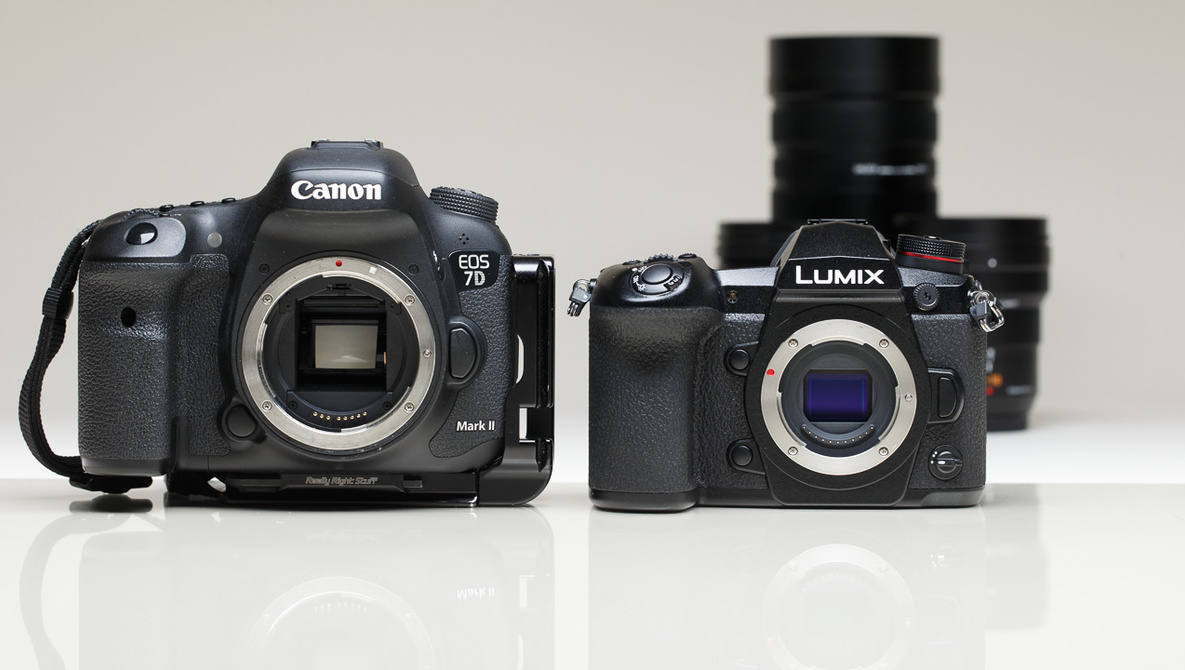
There are different sensor sizes in existence. This is common knowledge for most photo enthusiasts, and often it is said a full frame sensor is the professional choice. Let’s see if size makes a difference for your type of photography.
Although the different size photo sensors are something of the digital age, different film sizes already existed in the old days. Large format, medium format, 35mm film, and even smaller APS film and the 110 film cassettes. Of all these different film sizes, the 35mm film became the standard, measuring 24mm x 36mm. It was used in an extensive range of cameras, from the simple consumer compact cameras up to the professional SLR cameras. The much smaller 110 film cassettes were almost foolproof and used for cameras like the Kodak Pocket Instamatic. The APS was introduced as an Advanced Photo System, and could be used for high definition, classic, and panoramic pictures. It never really took off and the 35mm film stayed the standard in film sizes.
Now we have the digital full frame sensor, which has the same size as the 35mm film. It is often considered as the best sensor size available, or perhaps affordable one. Today everything is related to this sensor size. When we talk about focal length, which is a given physical number, it is always converted to full frame equivalent. And often we do the same with depth of field.
It is not wrong to have a standard. That is why we also use a meter, and kilogram, and liter. But it does not mean the standard is always the best option to use. Just like we use a centimeter instead of meter, it may be easier to use smaller sensors for some types of photography. Or larger sensors, of course.
The Different Sensor Sizes
Throughout the digital era we have seen a lot of different sensor sizes hit the market. It all started with small 1/3.5” sensors (3 x 4mm) in point and shoot cameras. Sensors grew up to 1/2” (6.4 mm x 4.8mm) and 1” (12.8mm x 9.6mm), which are still widely used. Larger sizes like the micro 4/3 (17.8mm x 13.4mm) appeared, and the well-known 1.5 and 1.6 crop sensors, about similar in size to the APS from old days. Finally we have the full frame sensors and the even larger medium format sensors.
On the other end we see the minute sensors for smartphone cameras appear, like a 1/5” (2.55mm x 1.91mm) and even 1/7” (1.85 x 1.39mm). Although you would think these sensors cannot produce any decent image, the quality has improved dramatically of the last few years. Photos from these sensors have become usable for a lot of purposes.
So there are a lot of sensor sizes to choose from. It is not realistic to divide these sensor sizes into consumer or professional. I think each of these sensor sizes can coexist, both for professional and amateur, and some of these sensors may even be ideal for a certain purpose. Because sensor sizes are almost always related to a certain type of camera, I will mention the different cameras and for whom I think they’re perfect for.
Compact Cameras
These have the smaller sensor sizes, often measuring between 1/3.6” up to 1/2″. The small size make it possible to keep these cameras small, and easy to carry with you. Because of its small sensor size, the focal length can be very short, thus resulting in a very large depth of field. These sensor sizes are not for the photographer that love a shallow depth of field, or need to use high ISO values, because the sensors will produce a lot of noise with the increase in ISO.
Bridge and Super Zoom Cameras
The 1/2″ and 1”sensors are often used in the larger compact and the super zoom cameras. Although these sensors are larger than the regular compacts, they are still very small, making it possible to retrieve large magnifications with short focal lengths. These super zoom cameras can reach focal lengths that are similar to 1000mm or even 2000mm on a full frame, while still having a relative small size.
These cameras are perfect for the photographer who love to use very long focal lengths, but don’t want to carry large cameras and lenses. But just like the compacts, a shallow depth of field is nearly impossible to use.
Micro 4/3 Cameras
Measuring only half the size of a full frame sensor, these micro 4/3 sensors are used in the system cameras with interchangeable lenses. The small size make it possible to retrieve large depth of fields and it makes the focal length twice as long compared to full frame. It is ideal for the wildlife photographer that loves the use of long focal lengths, and a landscape photographer that uses a maximum depth of field. It is not ideal for the portrait photographer, who wants a shallow depth of field.
Because the sensor does not need large and heavy lenses, the camera system is easy to carry with you while still having a large focal length available. Travel photographers can benefit from this.
APS-C Cameras
The well known 1.5 and 1.6 crop sensors, that can be found in the DSLR and mirrorless systems, are the perfect middle ground between small size sensor cameras as mentioned previously, and the larger size sensors. They have the benefit from a focal length multiplication of 1.5x or 1.6x, and make both shallow depth of field as well as large depth of field possible.
The camera size is larger than the cameras with smaller sensors, but not as large or bulky as the full frame versions. I think these cameras are the best choice of the all round photographer. A downside is the increased noise level at high ISO compared to larger sensors.
Full Frame Cameras
Finally we have the full frame sensor, the holy grail for many photographers. Perhaps that is a bit exaggerated, but it is almost always considered the best choice. And indeed, this sensor size is very good to use for portraits concerning depth of field. But I think it is not the best choice for people who need very long focal lengths, or when very large depth of field is needed, like in landscapes.
The balance between the size and amount of pixels make a relatively good high ISO performance considered. The full frame cameras need large and often heavy lenses, making the camera with these sensors not ideal for traveling.
Medium Format Cameras
Larger sensors are called medium format sensors. These often have a crop factor of 0.7, making a huge resolution possible. At the same time these sensors perform very well with dynamic range and high ISO, at least, in the last few years. Medium format cameras have become less expensive, thanks to the mirrorless techniques, and are well within reach of the professional and enthusiastic amateur photographer. Although the lack of a mirror makes these cameras less bulky than previously, the lenses are still large and heavy.
I think these cameras are perfect for studio environments, and situations when high resolution and a smooth depth of field is needed. These cameras seem have an appeal for landscapes, but the large sensor makes it difficult to obtain a really large depth of field.
Choose Wisely
If you want a camera for a certain kind of photography, it might be good to look beyond the inevitable advice by many to buy a full frame camera. Choose the camera with a sensor size that suits your preferred photography the best. Think of focal length magnification, depth of field, size, and weight, among other things.
Did you choose your camera and sensor size with your type of photography in mind? I would love to read about it in the comments below.