

Over the weekend, we reported that Intel has a new family of NUC small form factor PCs on the horizon with Comet Lake-U processors. The leak pointed out a number of SKUs with Core i3, Core i5, and Core i7 processor options available for customers.
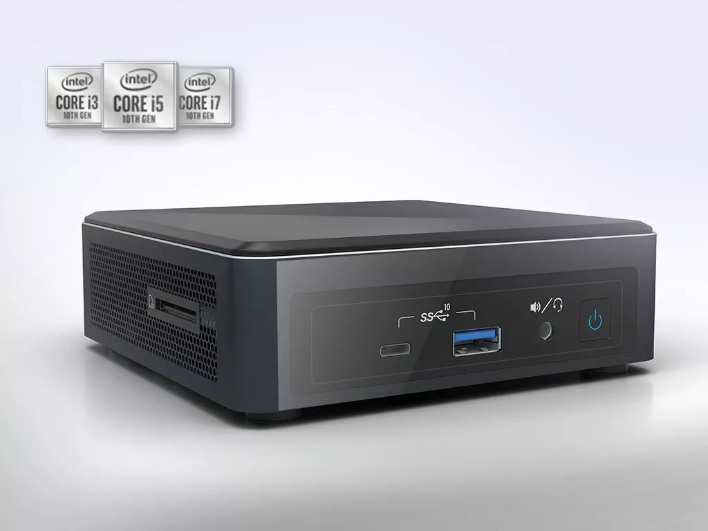
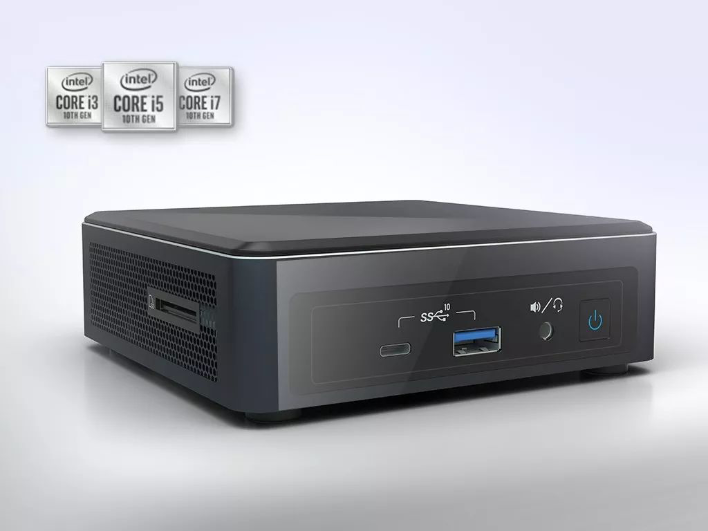
Today, one of our favorite leakers, momomo_us, managed to find quite a few images detailing Intel’s new “Frost Canyon” NUCs. Looking at these images, we’re not seeing a drastic design overhaul with Frost Canyon; the chassis design still looks very familiar to those that have been following Intel’s NUC family over the years — including the most recent Coffee Lake-powered offerings.

The biggest change that we spy is on the front panel, where one of the USB 3.1 Type-A connectors has been swapped in favor of a more “modern” Type-C connector. Also on the front is a combo audio jack and the requisite power button. Out back, there’s an HDMI port, GbE port, two additional USB 3.1 Type-A ports, and a single Thunderbolt 3 connector. On the left side of the chassis is a microSD reader.

A separate leak confirms the three processors — which we first reported on Sunday — that will be available in the Frost Canyon NUCs:
- Intel Core i3-10110U (4.7GHz Turbo, 2 cores/4 threads, 4MB L3 cache)
- Intel Core i5-10210U (4.2GHz Turbo, 4 cores/8 threads, 8MB L3 cache)
- Intel Core i7-10710U (4.1GHz Turbo, 6 cores/12 threads, 12MB L3 cache)

All three processors are rated with a TDP of 25 watts, which is the higher of the two configurations that Intel specifies for Comet Lake-U (with the other being a lower 15W TDP). All of the processors are based on Intel’s 14nm++ process tech.
According to FanlessTech, these new Intel Frost Canyon NUCs will arrive on December 12th.
‘).insertAfter(jQuery(‘#initdisqus’));
}
loadDisqus(jQuery(‘#initdisqus’), disqus_identifier, url);
}
else {
setTimeout(function () { disqusDefer(); }, 50);
}
}
disqusDefer();
function loadDisqus(source, identifier, url) {
if (jQuery(“#disqus_thread”).length) {
jQuery(“#disqus_thread”).remove();
}
jQuery(‘
‘).insertAfter(source);
if (window.DISQUS) {
DISQUS.reset({
reload: true,
config: function () {
this.page.identifier = identifier;
this.page.url = url;
}
});
} else {
//insert a wrapper in HTML after the relevant “show comments” link
disqus_identifier = identifier; //set the identifier argument
disqus_url = url; //set the permalink argument
//append the Disqus embed script to HTML
var dsq = document.createElement(‘script’); dsq.type = ‘text/javascript’; dsq.async = true;
dsq.src = ‘https://’ + disqus_shortname + ‘.disqus.com/embed.js’;
jQuery(‘head’).append(dsq);
}
jQuery(‘.show-disqus’).show();
source.hide();
};
function disqusEvent()
{
idleTime = 0;
}