

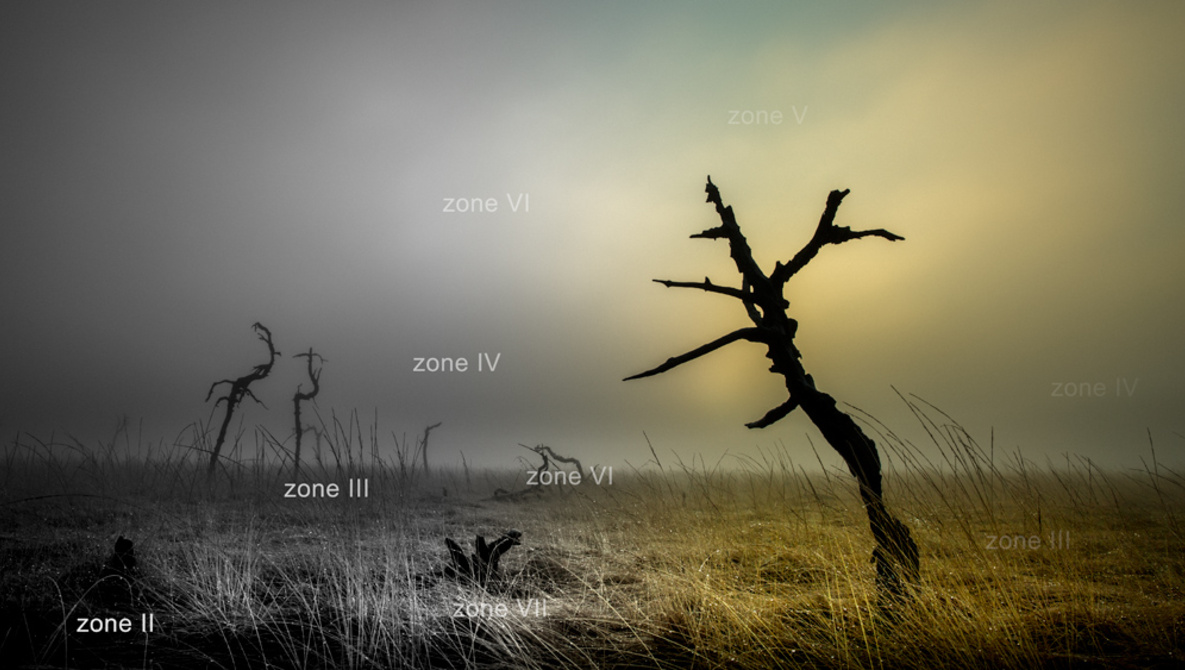
Our histogram shows 256 shades of gray. Besides pure black and pure white Ansel Adams used only nine shades to manipulate the contrast in his famous landscape photos. His zone-system can still be used for our modern digital photography.
Every landscape photographer has heard about Ansel Adams or will eventually come across that name. The famous American is mostly known for his black and white photos of Yosemite National Park. The 1941 photo Moonrise, Hernandez, New Mexico is probably his best-known photo.
One of the reasons why Adams is seen as a great photographer is because of his famous zone-system. With this system Adams was able to perfectly control the contrast in his black and white photos. Adams base rule was: “Expose for the shadows; develop for the highlights.”
The zone-system of Ansel Adams divides the photo into eleven zones; nine shades of gray, together with pure black and pure white. You could assume that a normal photo does not contain pure black and pure white. Therefor the nine shades of gray would be the only zones you can find in a photo.
Adams, who photographed in black in white negative film made sure to expose for the darkest parts of his scenery. This way he prevented to have pure black in the photo. When developing his photo paper, he made sure to manipulate the dark and light parts in his photo in such a way, that the shades of gray would follow his zone system.
Because Adams made sure to prevent having pure black, he managed to make optimum use of the dynamic range of his black and white film. During the development he was able to dodge and burn the shades of gray to end up with the best possible contrast.
Unfortunately, it is not possible to adapt his way of photographing in the digital photography. When we expose for the dark parts of the photo, the risk of overexpose light areas will occur. We all know, with digital photography overexposed areas cannot be recovered in any way. We all have heard the term for that kind of over exposure: blown out highlights.
This is also the main difference with analogue film. With analogue film, underexposure is not recoverable, and overexposure is recoverable. With digital photography it is just the way around, up to a certain point, of course. This means the base rule of Ansel Adams is not usable for digital photography.
Does this mean the zone-system is cannot be used for digital photography? Fortunately it can still be used. Instead of expose for the shadows, and develop for the highlights, we need to expose for the highlights and develop for the shadows. It is just a small, but very important change.
When we translate this to modern digital photography we see how this new base rule resembles Exposure to the Right (EttR). Exposure to the Right is nothing more than expose for the highlights, which translates to a histogram that is placed at the right side of the graph, while making sure no highlight is blown out. It is the only way to maintain as much information as possible in the dark shades of gray. And with a little luck, thus preventing to have pure black in the image.
Exposure to the Right, and expose for the highlights, will not deliver an image that is usable without a proper post-processing. It is essential to manipulate the shades of gray in such a way to end up with the perfect contrast. The use of a raw file format is very important, because only then you will have the ability to use the maximum dynamic range of the digital sensor. When post-processing your raw image it is possible again to use the nine shades of gray from the zone-system that Ansel Adams invented.
When using Lightroom you can use the sliders highlight and shadow to manipulate the shades of gray. The black point and white point slider will let you manipulate the boundaries, and locale adjustments make it possible to optimize any part of the photo to your liking. With proper post-processing you will end up with a perfect contrast in your black and white photo. It is almost as if we stepped into the darkroom of Ansel Adams again.
How about color? The zone-system of Ansel Adams is invented for black and white photography, of course, but it can be used for color photography as well. Sometimes it can be difficult to recognize the different highlights in a color photo. By temporary converting it to black and white, it might become possible to successfully use the zone-system of Ansel Adams again. You can read more about this method in my previous article.
Have you ever used the zone-system for your photography, either for black and white or for color? Or do you think this method is outdated and not suitable for digital photography. I love to read about your opinion in the comments below.