

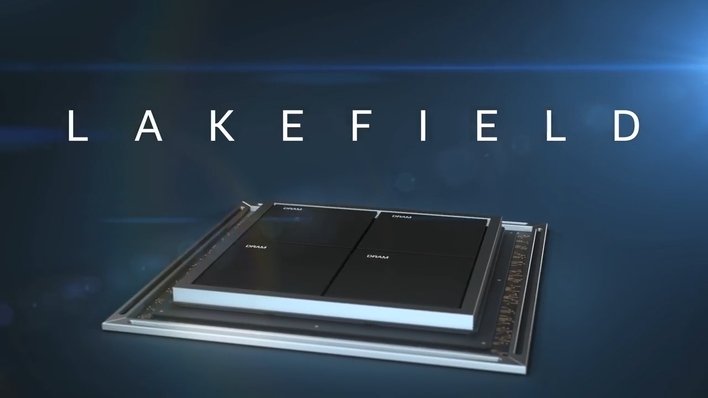
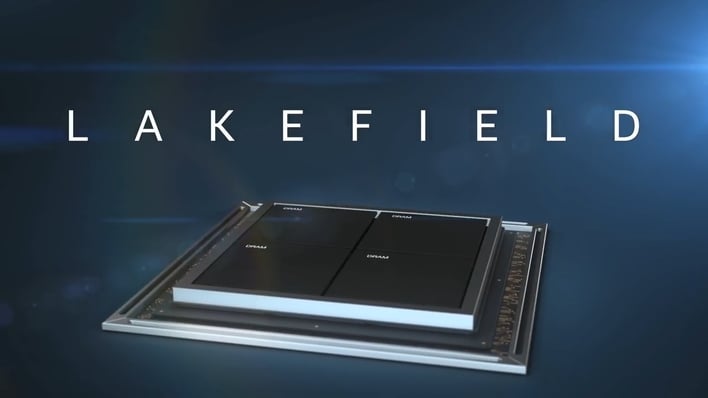
There’s been lot of talk about Intel’s 14nm Comet Lake and 10nm Tiger Lake processor architectures in recent months, but there’s another revolutionary chip architecture also waiting in the wings: Lakefield. Lakefield uses Intel’s Foveros 3D stacking technology and is built on the 10nm process node.
Tech sleuth TUM_APISAK located a UserBenchmark score from a previously unseen Core i5-L16G7. The “L” designation seemingly references its Lakefield roots, and it is a strange chip indeed. According to UserBenchmark, Core i5-L16G7 has a total of 5 cores with HyperThreading disabled, which means that it can execute 5 threads.
In this case, the Core i5-L16G7 has a single high-powered Sunny Cove core that is joined by four lower-power Tremont cores. In a way, this somewhat similar to ARM’s big.LITTLE arrangement that we see in modern Exynos and Snapdragon SoCs.

The chip is pegged as having a 1.4GHz base clock and a turbo frequency of 1.75GHz. If previous reports are accurate, Lakefield CPUs will also include Gen11 graphics (sorry for those of you expecting Gen12 Xe graphics).
The Core i5-L16G7 was found nestled within a device labeled Samsung 767XCL. If we had to take a guess, we’d imagine that this is the upcoming Galaxy Book S that Samsung announced back in late October. At the time, Samsung said that the device would use a Lakefield processor.
At the time, Samsung didn’t give a specific launch date for the device, but it did say that it would be the first Lakefield-powered product on the market. However, following the new Galaxy Book S’ debut, it will be followed by Microsoft’s intriguing Surface Neo using the same processing platform.
‘).insertAfter(jQuery(‘#initdisqus’));
}
loadDisqus(jQuery(‘#initdisqus’), disqus_identifier, url);
}
else {
setTimeout(function () { disqusDefer(); }, 50);
}
}
disqusDefer();
function loadDisqus(source, identifier, url) {
if (jQuery(“#disqus_thread”).length) {
jQuery(“#disqus_thread”).remove();
}
jQuery(‘
‘).insertAfter(source);
if (window.DISQUS) {
DISQUS.reset({
reload: true,
config: function () {
this.page.identifier = identifier;
this.page.url = url;
}
});
} else {
//insert a wrapper in HTML after the relevant “show comments” link
disqus_identifier = identifier; //set the identifier argument
disqus_url = url; //set the permalink argument
//append the Disqus embed script to HTML
var dsq = document.createElement(‘script’); dsq.type = ‘text/javascript’; dsq.async = true;
dsq.src = ‘https://’ + disqus_shortname + ‘.disqus.com/embed.js’;
jQuery(‘head’).append(dsq);
}
jQuery(‘.show-disqus’).show();
source.hide();
};
function disqusEvent()
{
idleTime = 0;
}